News

News

Get the newest news about Nanhaiya’s new products, production process, industry trends and global cooperation. Stay updated with leading screw barrel manufacturer.
How to clean a single screw extruder without damaging the screw or barrel28 2026-08

How to clean a single screw extruder without damaging the screw or barrel

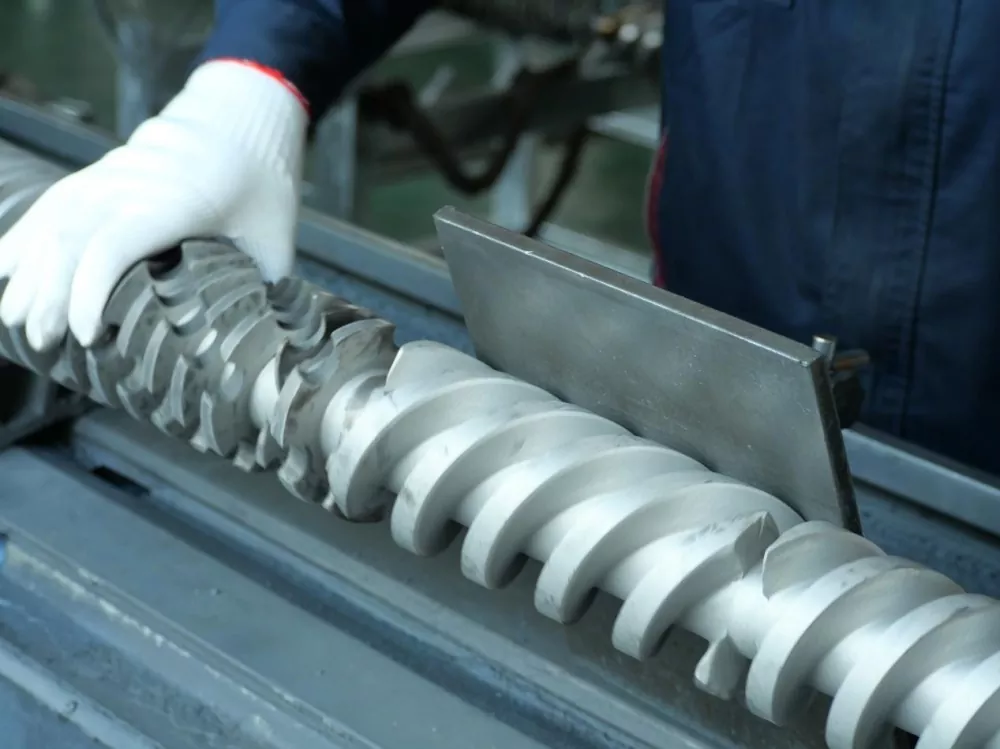
Use a layered method. Start with the material and machine supplier's approved purge procedure while the extruder remains under normal operating control. If residue returns or the screw must be exposed, stop, isolate and verify hazardous energy according to the plant procedure. For a removed screw, use component-approved non-damaging tools. Industry guidance recommends brass tools, copper gauze and cotton cloth, and warns against steel scrapers and localized torch heating. Inspect the clean surfaces before deciding that the problem is wear.
Single screw design for granulation: venting, mixing and recycled feedstock25 2026-08

Single screw design for granulation: venting, mixing and recycled feedstock

Specify a granulation single screw in this order: feedstock, required melt preparation, venting load, mixing duty, filtration resistance and pelletizing method. State whether the feed is clean pellet, powder, agglomerate, washed flake or a variable recycled stream. Provide resin grade, MFR test condition, moisture, contamination, filler, target output, motor, rpm, vacuum arrangement and current symptoms. The screw can then be designed around a real material window instead of a nominal diameter.
How to choose a single screw for LDPE, LLDPE and HDPE film blowing25 2026-08

How to choose a single screw for LDPE, LLDPE and HDPE film blowing

Choose a film-blowing screw in this order: resin and formulation, finished film and layer structure, line duty, then screw geometry and surface system. Ask for the exact resin grade and melt flow test condition, not only “LDPE,” “LLDPE” or “HDPE.” Record the blend ratio, additives, recycled content, output, screw speed, motor, die, film width and thickness range. Only then decide diameter, L/D, feed depth, melting profile, metering section and whether a barrier or mixing section is justified.
How to measure single screw and barrel wear before replacement24 2026-08

How to measure single screw and barrel wear before replacement

Measure wear as a location-based pair, not as one screw diameter. Mark axial stations through the feed, compression and metering zones. At each station, record the screw flight outside diameter and the barrel inside diameter in multiple angular directions. Then calculate diametral and radial clearance separately. Compare the map with the original approved drawing or a clearly agreed design reference. If you have only the worn parts, label the results as condition data. Do not present them as original dimensions.
Should you replace only the screw or both the screw and barrel?24 2026-08

Should you replace only the screw or both the screw and barrel?

Replace only the screw when measured barrel bore, roundness, surface condition and alignment remain suitable for the proposed new screw. Replace both parts when the barrel is enlarged, oval, locally washed out, scored or corroded enough that the new screw would still run with excessive or uneven clearance. If you do not have bore measurements, do not guess. Our factory position is simple: a screw-only quotation should not be treated as a complete technical recommendation until the barrel condition has been checked.
Barrier Screw vs Conventional Screw vs Mixing Screw: What Changes in the Melt?20 2026-08

Barrier Screw vs Conventional Screw vs Mixing Screw: What Changes in the Melt?

Choose a conventional screw for a stable, uniform pellet feed and moderate output when simple operation is the priority. Choose a barrier screw when the line needs more complete melting and stable output at higher rates, especially for PE and PP. Choose a mixing screw when melt-temperature uniformity, color distribution or additive dispersion is the main problem. Barrier and mixing functions are not mutually exclusive. Nanhaiya’s aluminum-plastic panel single screw, for example, uses a barrier-type mixing section to support melting, melt-temperature uniformity and the distribution of colorants and flame retardants.
X
We use cookies to offer you a better browsing experience, analyze site traffic and personalize content. By using this site, you agree to our use of cookies.Privacy Policy
RejectAccept