News

Industry News

Should you replace only the screw or both the screw and barrel?24 2026-08

Should you replace only the screw or both the screw and barrel?

Replace only the screw when measured barrel bore, roundness, surface condition and alignment remain suitable for the proposed new screw. Replace both parts when the barrel is enlarged, oval, locally washed out, scored or corroded enough that the new screw would still run with excessive or uneven clearance. If you do not have bore measurements, do not guess. Our factory position is simple: a screw-only quotation should not be treated as a complete technical recommendation until the barrel condition has been checked.
Barrier Screw vs Conventional Screw vs Mixing Screw: What Changes in the Melt?20 2026-08

Barrier Screw vs Conventional Screw vs Mixing Screw: What Changes in the Melt?

Choose a conventional screw for a stable, uniform pellet feed and moderate output when simple operation is the priority. Choose a barrier screw when the line needs more complete melting and stable output at higher rates, especially for PE and PP. Choose a mixing screw when melt-temperature uniformity, color distribution or additive dispersion is the main problem. Barrier and mixing functions are not mutually exclusive. Nanhaiya’s aluminum-plastic panel single screw, for example, uses a barrier-type mixing section to support melting, melt-temperature uniformity and the distribution of colorants and flame retardants.
Why Does a Single Screw Extruder Surge? A Step-by-Step Diagnostic Guide20 2026-08

Why Does a Single Screw Extruder Surge? A Step-by-Step Diagnostic Guide

A single screw extruder surges when material flow through the line stops being steady. Common sources include inconsistent feeding, screw-speed variation, unstable barrel temperature, incomplete or unstable melting, a changing screen or die restriction, screw-and-barrel wear, and downstream speed variation. Record melt pressure, motor current, screw speed, zone temperatures, feed rate and downstream speed on the same timeline before changing settings. If pressure and output move together, investigate the extruder and flow path. If the extruder trends stay stable while the product changes, start with the die, cooling, vacuum, haul-off or winder.
How to Specify a Replacement Single Screw: Measurements, Drawings and RFQ Checklist20 2026-08

How to Specify a Replacement Single Screw: Measurements, Drawings and RFQ Checklist

To specify a replacement single screw, send four groups of information: machine and interface details, a controlled dimensional record, the processed material and operating duty, and clear acceptance requirements. A worn sample helps, but it is evidence of both the original design and subsequent damage. The factory must distinguish between the two before approving a drawing.
How Screws and Barrels Are Manufactured: A Factory-Stage Guide20 2026-08

How Screws and Barrels Are Manufactured: A Factory-Stage Guide

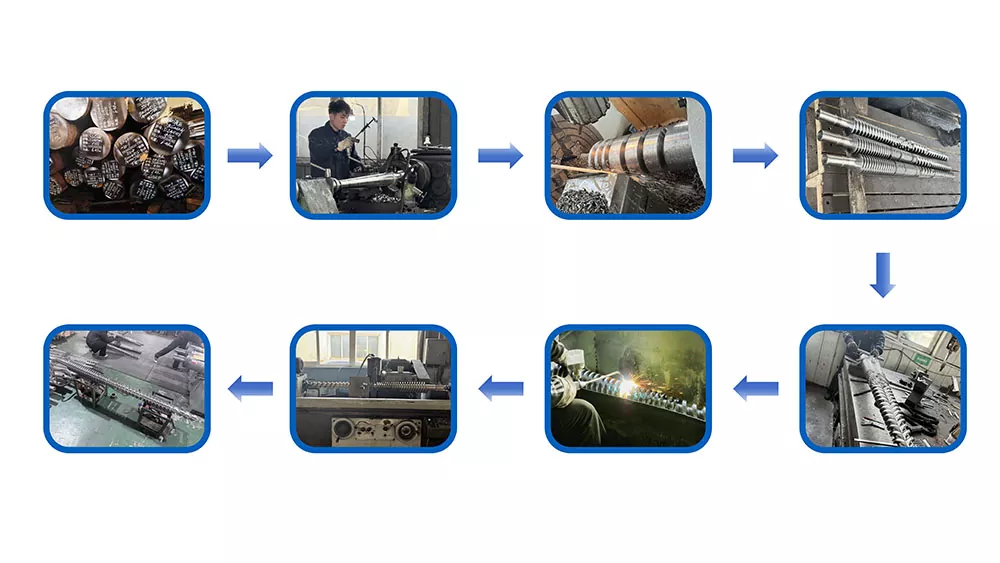
The screw and barrel manufacturing process usually includes application review, material and surface-system selection, blank preparation, rough and finish machining, heat treatment or hardfacing, precision finishing, dimensional inspection and protected packing. The order is not universal. It must be planned around the geometry, treatment and final dimensions of the specific part.
Parallel Twin Screw Extruder: How Co-Rotating Compounding Works14 2026-08

Parallel Twin Screw Extruder: How Co-Rotating Compounding Works

A parallel twin screw extruder has two constant-diameter intermeshing screws built from modular elements. Most are co-rotating, running at high speed for intensive mixing — which makes them the standard machine for compounding, masterbatch, WPC and pelletizing. Unlike a conical machine, the screw profile can be rebuilt for each new formulation.
X
We use cookies to offer you a better browsing experience, analyze site traffic and personalize content. By using this site, you agree to our use of cookies.Privacy Policy
RejectAccept