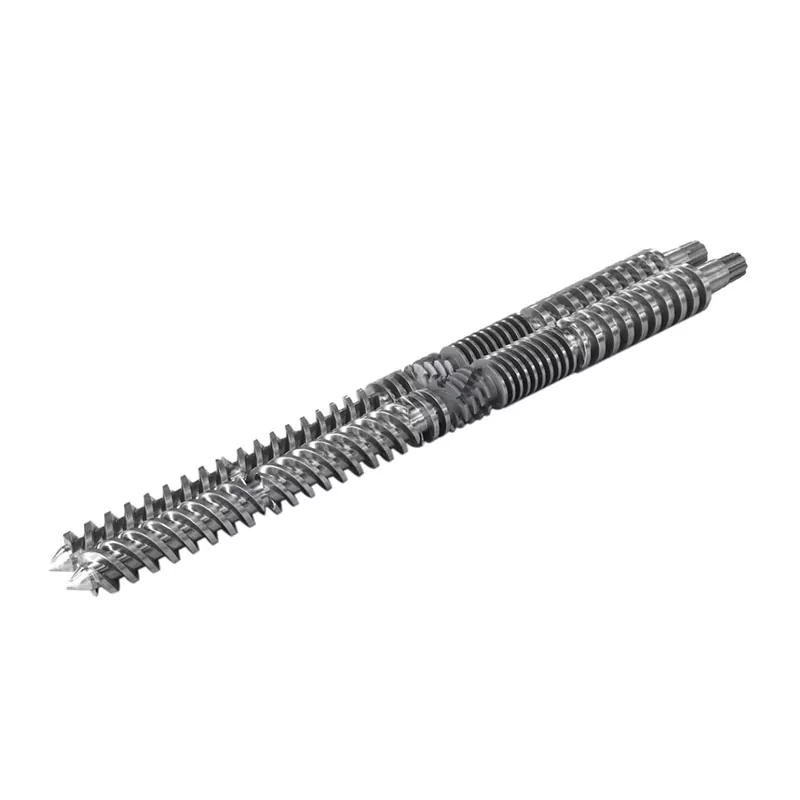

What is the difference between distributive and dispersive mixing?
Think of distribution as a question of location and dispersion as a question of the size of domains or agglomerates. Moving a large pigment clump into another part of the melt changes its location. Breaking that clump into smaller agglomerates changes its dispersion. One result does not establish the other.
| Question | Distributive mixing | Dispersive mixing |
|---|---|---|
| What should change? | Spatial uniformity of components. | Agglomerate or dispersed-phase size. |
| What does the flow do? | Split, reorient and recombine material. | Apply sufficient stress for deformation or breakup. |
| What should we examine? | Composition or color consistency across defined samples. | Remaining agglomerates or phase morphology. |
| What is insufficient proof? | A fine particle size in one isolated sample. | A uniform-looking pellet color. |
The distinction is explained in NC State Extension's screw-functionality guide. Most real elements contribute to both processes. The useful question is whether the material receives the required balance, not whether an element belongs permanently in one category.
For purchasing, write the desired result as an observable requirement. Identify what must become more uniform, which agglomerates or phase features are unacceptable, and how the laboratory will report them. A request for "better mixing" leaves those decisions unresolved.
This guide concerns co-rotating twin-screw compounding. Establish the equipment duty first if you are comparing a single-screw line or an opposing-rotation PVC process. Our single-screw versus twin-screw material guide addresses that broader choice.
Diagnose the defect before changing the screw
Describe the defect before naming the replacement element. We would request samples tied to the same operating period as the feeder, speed, temperature and load records. A sample without its process conditions makes it difficult to distinguish a repeatable configuration problem from a temporary disturbance.
| Observation | Evidence we would request | First decision |
|---|---|---|
| Color changes over time | Time-labelled samples and feeder delivery records. | Investigate dosing consistency before changing geometry. |
| Visible specks | Sections or micrographs compared with incoming ingredients. | Identify agglomerates, unmelted material, degradation or contamination. |
| A defect began after a recipe change | Previous and current formulations, feed forms and settings. | Separate a new processing task from wear-related deterioration. |
What I check before recommending stronger mixing
When I assess a twin-screw mixing problem, I first separate uneven composition from particles that have not broken down. Visible specks in a pellet sample are not enough to justify a stronger kneading section. I ask for the resin grade, additive form and loading, current screw layout, feeding records, and samples collected under stable operating conditions.
My next step is to establish what those specks actually are. I would examine sections of the material and compare the defect with the original ingredients. Agglomerated pigment, unmelted resin and degraded material require different responses. Adding mixing intensity before identifying the defect can send the investigation in the wrong direction. The distinction between poor melting and poor mixing is also a central warning in Jim Frankland's single-screw mixing guidance.
For the screw review, I consider disc width, block length, stagger angle and conveying direction together. I also check the surrounding elements, feed locations and measured clearances. A kneading block cannot be assessed properly from its angle alone. Its position in the process and the material conditions entering it matter.
Before recommending a change, I would establish a baseline for throughput, actual melt temperature, drive load and the relevant quality measurements. I would then compare one justified configuration change after the process has stabilised, keeping the formulation and sampling method consistent. If feeding is unstable or the existing components are worn, I would resolve those issues before using a new mixing section to compensate.
My acceptance criterion is the agreed product specification. A configuration that removes visible agglomerates but damages the required fiber morphology or exceeds the operating limits is not an acceptable improvement. I would retain the configuration that delivers the required mixing quality within the line's thermal and mechanical limits, rather than continue adding restriction simply because the machine can tolerate it.
How twin-screw extruders generate mixing
Flow rearrangement and local stress do different jobs
Distributive action comes from repeated splitting, stretching and rearrangement of material. Dispersive action requires stresses sufficient to deform a dispersed phase or overcome resistance within an agglomerate. Shear and extensional flow describe deformation mechanisms; they are not separate quality targets that replace distribution and dispersion.
Charlie Martin's technical review of twin-screw continuous mixing describes the interaction of screw elements, filled processing regions and conveying sections. Its equipment discussion is useful here; pharmaceutical formulation conditions in that review should not be transferred to an industrial plastics recipe.
Speed is an input, not the acceptance result
For a local shear-flow interpretation, stress depends on the material's viscosity at the relevant temperature and deformation rate. An rpm figure alone does not define those conditions, as the particle-tracking comparison below illustrates. Compare a proposed speed change alongside the actual melt temperature, feed rate and quality results, rather than use speed as a substitute for a dispersion measurement.
Look beyond average residence time
Residence time distribution describes how long different portions of material remain in a process. For the review brief, ask where a tracer enters, where it is detected and which operating conditions apply. A mean value without that information is not enough to compare two layouts.
Our recommended trial record separates inputs from outcomes. Record settings and material delivery as inputs; record the finished material's consistency and morphology as outcomes. Keep temperature and load as operating constraints. This structure prevents a trial report from calling a higher energy input a quality improvement before the product has been assessed.
Extruder screw elements and their mixing functions
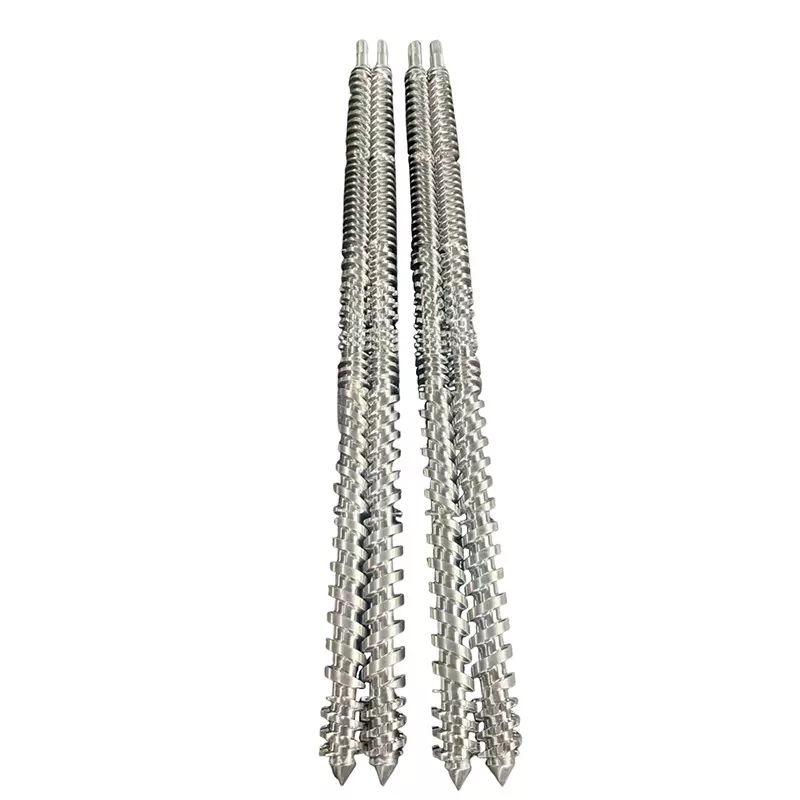
An element family is a useful starting label, not a complete performance specification. NC State's element guide distinguishes conveying, reverse, kneading and toothed elements and explains that nomenclature varies between manufacturers. We would use the actual drawing and geometry, rather than transfer another supplier's code to a quotation.
| Element family | Role to review | What we would request |
|---|---|---|
| Conveying | Transport and local filling conditions. | Lead, length, handedness and neighbouring restrictions. |
| Kneading block | Deformation, mixing and conveying or restriction. | Disc width, count, total length, stagger and conveying direction. |
| Toothed or dedicated mixer | Flow rearrangement and geometry-dependent stress exposure. | Complete profile, operating position and evidence for the intended task. |
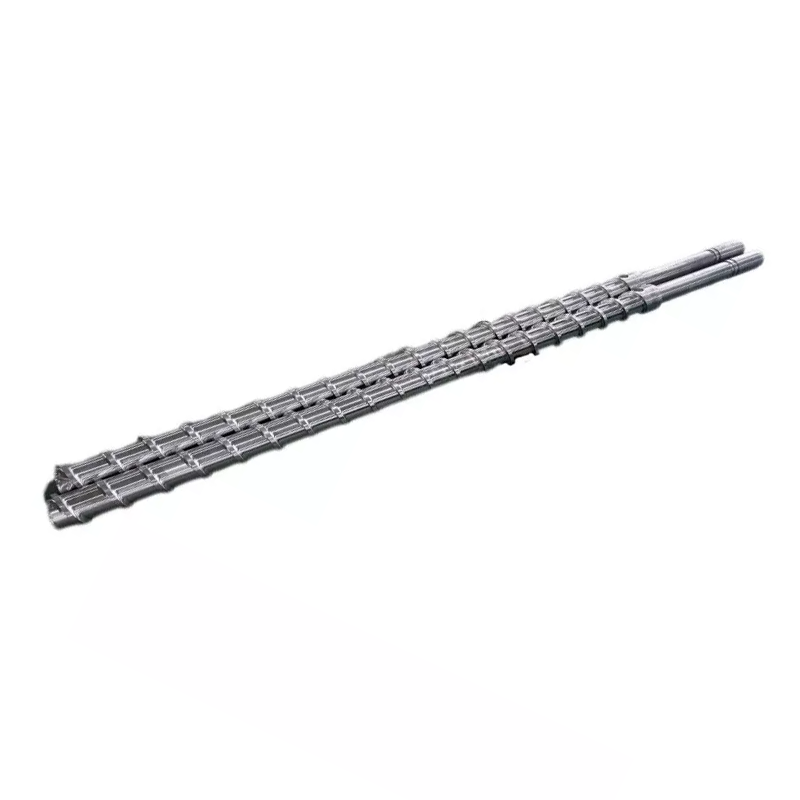
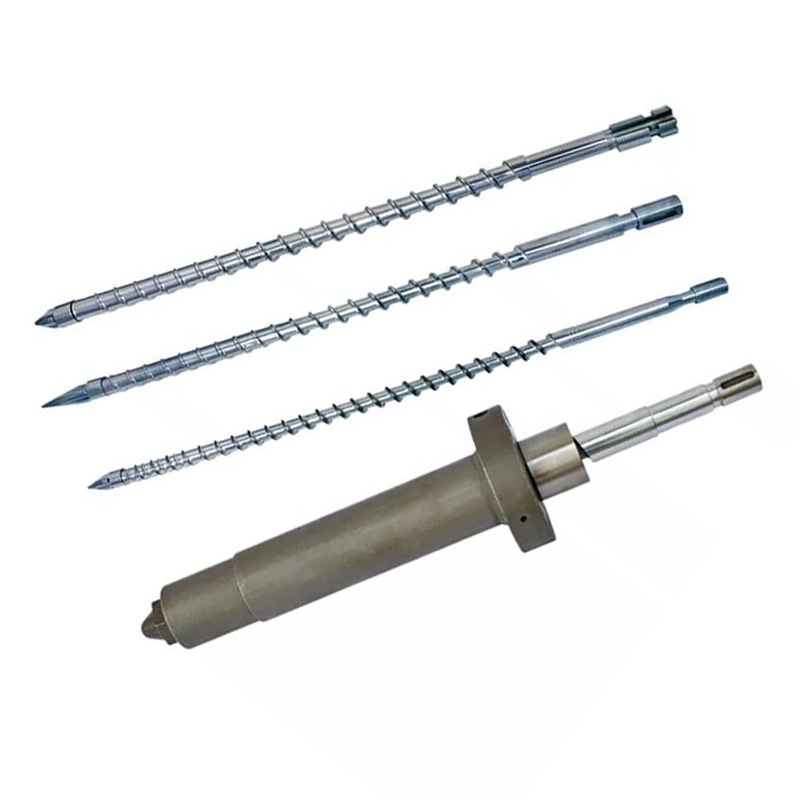
Do not assume that conveying elements contribute nothing to mixing, or that every toothed element is exclusively distributive. The right comparison is between defined geometries under stated conditions. Establish whether the drawing describes a segmented assembly or a one-piece screw before discussing replacement flexibility.
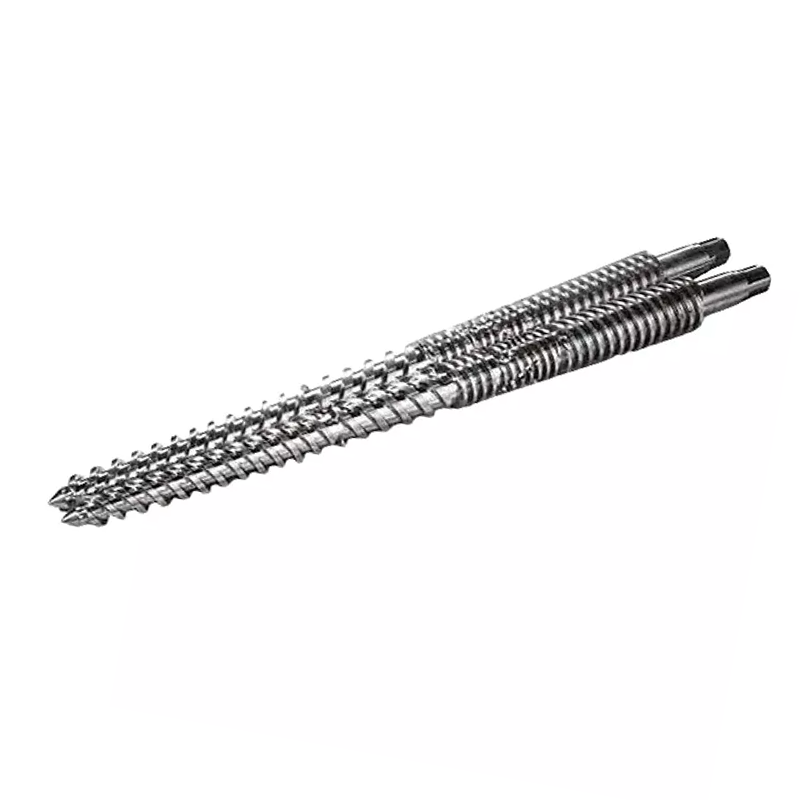
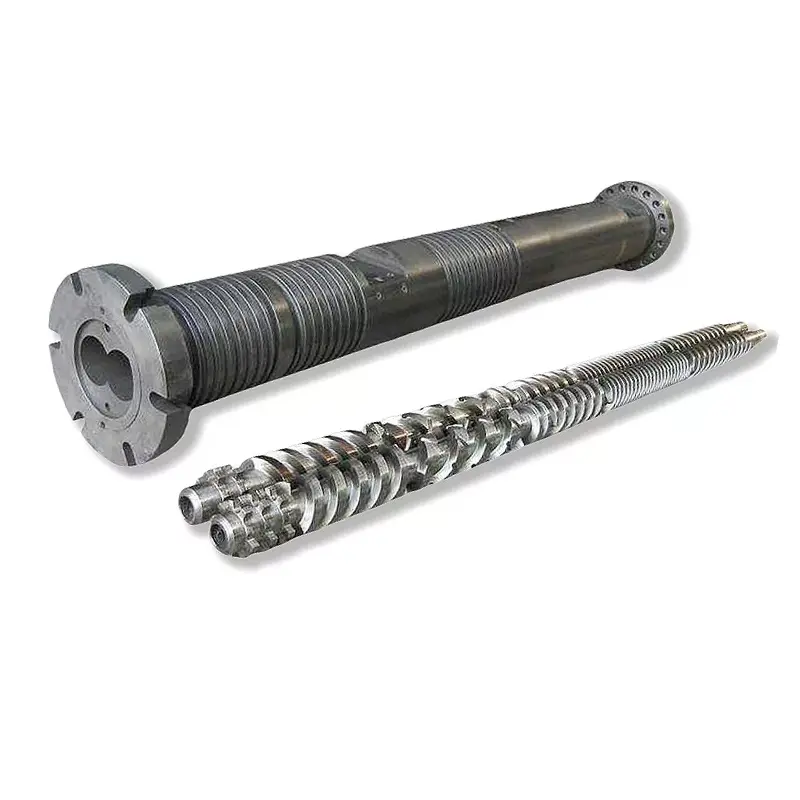
Our co-rotating parallel twin screw barrel product page identifies same-direction rotation, intermeshing and compounding applications. Those details establish the relevant equipment category. For an order, the approved configuration still needs to identify the individual working sections and mating interfaces.
Screw design features that control mixing, heat and wear
Separate disc width, disc count and block length
These are related dimensions, but they are not interchangeable descriptions. Kenneth Russell's twin-screw mixing analysis explains the familiar tendency for wider discs to favour dispersive action and narrower discs to favour division and redistribution. It also stresses the influence of restriction, filling and melt temperature.
That tendency is not a universal purchasing rule. If a comparison changes disc width, block length and conveying behaviour together, the result cannot be attributed to width alone. Ask which variable changed and which quality measurement improved.
Read stagger angle with conveying direction and fill
A neutral kneading block has no inherent forward pumping action; material can still pass through under the action of the surrounding process. Reverse elements oppose forward transport. Their usefulness depends on the intended filling and pressure conditions. Neither "neutral" nor "reverse" is an automatic instruction to improve every mixing section.
| Proposed change | Required comparison record | Reason to reject the trial |
|---|---|---|
| Different kneading geometry | Dimensions, element sequence, quality data and stable throughput. | The target defect remains or a required property deteriorates. |
| Greater restriction | Actual melt temperature, pressure, drive load and feeding/vent behaviour. | A machine or material limit is exceeded. |
| Restored working clearances | Matched screw/barrel measurements at named positions. | The assembly fails its approved fit or clearance requirements. |
Durability starts with the actual duty
We publish 38CrMoAlA and a nitriding-depth range of 0.50 to 0.70 mm on the co-rotating product specification. These are material and treatment data, not a mixing-quality rating or a service-life guarantee. They do not define the running clearance.
For an abrasive formulation, we would request the filler identity, loading and wear map before selecting the surface system. Geometry review and wear protection are separate decisions. A harder surface cannot demonstrate that an unsuitable mixing profile is correct. Our parallel twin-screw clearance and wear guide explains the matched inspection record.
Inspect components only under the plant's approved isolation, cooling and handling procedures. Do not reduce a clearance or alter an assembly outside the machine maker's approved limits to seek more mixing.
How to arrange a twin-screw profile for mixing
Review the sequence of processing tasks before selecting a mixing block. Martin's continuous-mixing review describes metered feeding, conveying, melting, filled mixing regions and discharge. A profile has to provide those functions together. A stand-alone element recommendation leaves its inlet conditions and downstream pressure duty unspecified.
Define what reaches each mixing section
For a proposed change, state whether the ingredient enters as pellets, powder, liquid or a concentrate, and identify its feed position. We would ask what melting or wetting condition is required before the intended dispersion task. A mixing comparison should not conceal a change in how the ingredient enters the process.
Keep feeding, restriction and venting connected
Before adding a restrictive element, ask the process designer to check the pressure and filling requirements around side feeders and vents. We would not approve the change from a mixing-only sketch that omits those interfaces. Record the acceptable behaviour at each opening as part of the trial brief.
Identify where material temperature is measured and where the quality sample is taken. Otherwise, a hotter reading at a different location can be mistaken for a temperature rise caused by the new element. Keep the measurement locations fixed when the purpose is a direct comparison.
Match the mixing balance to the formulation
Specify the ingredient as it enters the extruder. A pre-dispersed color concentrate and an agglomerating raw pigment do not present the same task. We would request the supplier's material information and examine the incoming form before deciding whether the principal need is redistribution, deagglomeration or both.
| Material brief | Question to answer | Evidence to include in acceptance |
|---|---|---|
| Pre-dispersed color masterbatch | Is dosing and distribution consistent, and are residual agglomerates present? | Time/position sampling, color consistency and applicable dispersion assessment. |
| Agglomerating pigment or mineral filler | Has the ingredient been wetted and have unacceptable agglomerates remained? | Defined agglomerate measurements and required product properties. |
| Glass-fiber compound | Does the blend meet uniformity and retained-fiber requirements? | Fiber morphology and the specified mechanical properties. |
| Polymer blend or heat-sensitive compound | What phase morphology and temperature/time limits apply? | Morphology, degradation indicators and relevant finished-product tests. |
Russell's mixing discussion uses cohesive carbon black as an example of a material needing dispersion and contrasts intensive sections with gentler treatment of fibers. That supports a material-specific brief, not a rule that every filled material needs the most restrictive configuration.
Do not quote one profile for every granulation duty
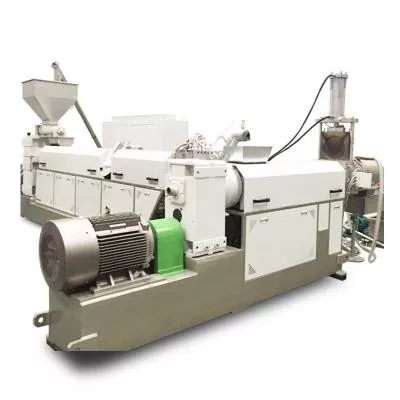
Our granulation parallel twin screw page lists thermoplastic pellet production, including PE and PP, and supports virgin and recycled materials with configuration customization. For a quotation, those broad categories must be narrowed to the actual grade, additive loading, feed form and required product.
We would ask whether a recycled feed has changed composition or contamination level before attributing a new defect to the screw. Likewise, we would not accept a color-only check for a fiber-reinforced grade whose purchase specification includes mechanical performance. The acceptance test should follow the reason the additive is present.
How to verify mixing quality instead of guessing
Why I compare stress exposure rather than screw speed alone
I would use the study by Jan Philipp Oldemeier and Volker Schöppner as a useful starting point when comparing mixing configurations. Their research examined screw elements using three-dimensional flow simulation and particle tracking, rather than assuming that every particle experiences the same mixing conditions.
For the ZSK25 geometry with PP FPH50, the researchers specified a melt temperature of 220°C and a throughput of 20 kg/h. Increasing the toothed mixing element's speed from 200 to 400 rpm raised the mean of the tracked particles' maximum shear stresses from approximately 37,900 to 54,400 Pa. For the KB24 kneading block under the same conditions, the corresponding values increased from approximately 27,900 to 48,400 Pa.
These were simulated stress results, not measured improvements in finished compound quality. The authors also stated that experimental validation was still pending. Read the original study.
My engineering conclusion is that speed alone is an incomplete specification. Before recommending either element for production, I would require evidence that its stress exposure addresses the actual defect, followed by checks on dispersion, melt temperature, drive load and the product's required properties.
Choose a test that fits the specimen
ISO 23900-5:2015, confirmed in 2025, describes the filter pressure value test for assessing colorant dispersion in thermoplastic polymers. It is a relevant method to consider for color concentrates used in extrusion and melt spinning; the laboratory must establish the applicable preparation and test conditions.
ISO 18553:2025 addresses particle/agglomerate size and dispersion rating in polyolefin pipes, fittings and compounds. Its stated scope includes carbon black content below 3% by mass and pigment content below 5%. Do not apply that scope automatically to a highly concentrated masterbatch or to every filler system.
Separate the quality record from the operating record
For distribution, define where and when samples are taken and what consistency measurement is appropriate. For dispersion, define the specimen preparation and the relevant agglomerate or morphology assessment. Agree the acceptance criteria with the product specification and laboratory before the trial, rather than choosing a pass threshold after seeing the result.
For energy comparisons, state whether the reported value is drive input, estimated shaft power or a wider line measurement, and identify the mass-flow basis. Do not compare unlike "SME" numbers or treat one average energy figure as proof of local stress exposure. We would record energy and load alongside quality, not replace the quality tests with them.
Our recommendation: retain separate columns for quality, stable accepted output, melt temperature and mechanical load. Approve the configuration only when it meets the agreed requirement in every relevant column.
Reviewing screw configuration for mixing quality and durability
Use a controlled review rather than a sequence of unrelated adjustments. The following workflow is our proposed method for turning a mixing complaint into a configuration brief. It does not authorize operation outside the machine maker's limits or substitute for the plant's change-control and safety procedures.
-
Define the defect and acceptance target
Describe the defect with representative samples and the required product specification. Decide which distribution, dispersion and finished-property measurements will determine acceptance before changing the line.
-
Record a comparable baseline
Record the formulation revision, ingredient form, feed rates, screw speed, measured melt temperature, pressures, drive load and stable accepted output. Label samples with the same operating period and measurement locations.
-
Check feeding, melting and wear
Review feeder consistency and identify the particles in the defect. If wear is suspected, obtain matched screw-and-barrel measurements under approved inspection procedures before recommending a revised mixing geometry.
-
Select one justified change
State the mechanism the change is intended to address. Document the element dimensions, direction, sequence and affected interfaces. Have the responsible process engineer approve the change and its operating limits.
-
Compare after the process stabilizes
Use the agreed stabilization and sampling procedure. Keep the formulation and test method consistent, record any unavoidable differences, and compare quality together with temperature, load and accepted output.
-
Accept, revise or return to the baseline
Accept the change only if it meets the predefined quality and operating criteria. If it fails, preserve the findings and follow the approved return or revision procedure instead of adding another restriction without a new hypothesis.
What we need for the component brief
Send the machine identity, configuration drawing, nominal screw diameter, centre distance, shaft or drive connection details, and any measured wear map. Include the material and operating records above. For a segmented system, identify the element sequence; for a one-piece screw, identify the working sections on the complete drawing. Mechanical fit and mixing performance need separate acceptance checks.
Frequently asked questions
Can distributive mixing break up pigment agglomerates?
Distributive mixing primarily redistributes material; it does not by itself establish that the available stress is sufficient to break an agglomerate. A real element can contribute to both mixing modes. Examine the residual agglomerates separately from color or composition uniformity before deciding whether more dispersive action is needed.
Does increasing screw speed always improve mixing?
No. Speed is an operating input, while acceptable mixing is a measured product result. Compare a speed change with feeding conditions, actual melt temperature, drive load and the agreed quality tests. Do not accept a higher rpm setting if the required product properties or operating limits are no longer met.
Are 90-degree kneading blocks always better for dispersion?
No. Stagger angle is only one geometry variable. Disc width, total block length, conveying direction, filling conditions and the surrounding configuration also need review. A neutral block can pass material under the action of the surrounding process; neutral does not mean that the material remains stationary.
Can toothed mixing elements also provide dispersive mixing?
Yes, depending on the geometry and operating conditions. An element described as a distributive mixer can still generate local stresses. Request evidence for the actual profile and material duty rather than treating the category name as a complete description of its performance.
Why can color streaks remain after adding more kneading blocks?
More kneading blocks do not identify or eliminate the cause by themselves. Check dosing stability, incoming ingredient form, melting conditions and samples collected under comparable operation. Then determine whether the remaining problem is spatial distribution, undispersed agglomerates or another defect before making a further configuration change.
What does screw blade configuration mean in twin-screw extrusion?
For this guide, the useful configuration is the axial arrangement of conveying, kneading and mixing sections, including their dimensions and direction. Use those specific terms on the drawing. Calling the entire assembly a blade configuration does not specify its processing functions or make different suppliers' element codes interchangeable.