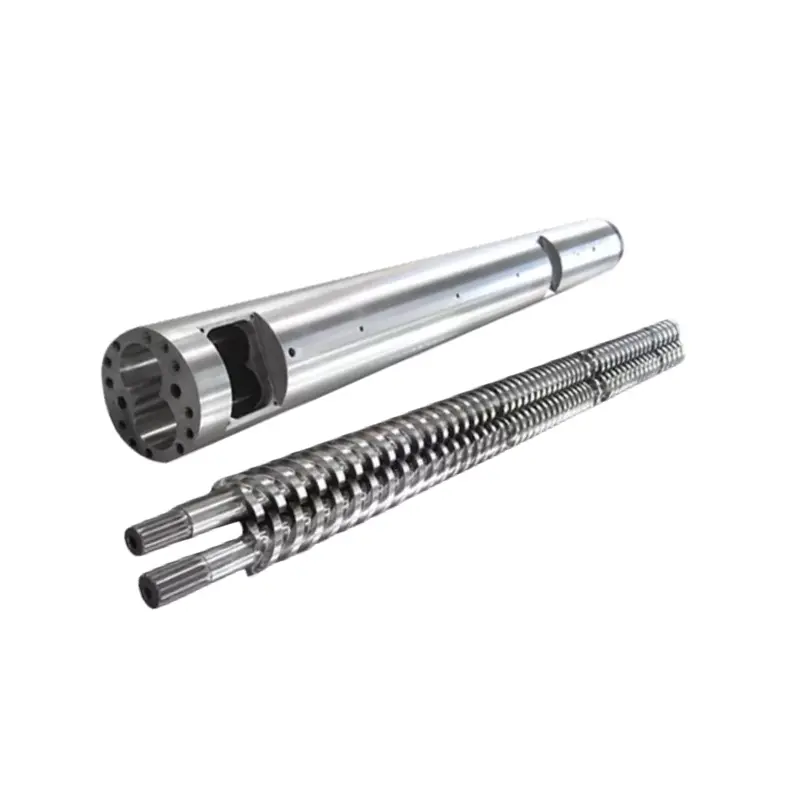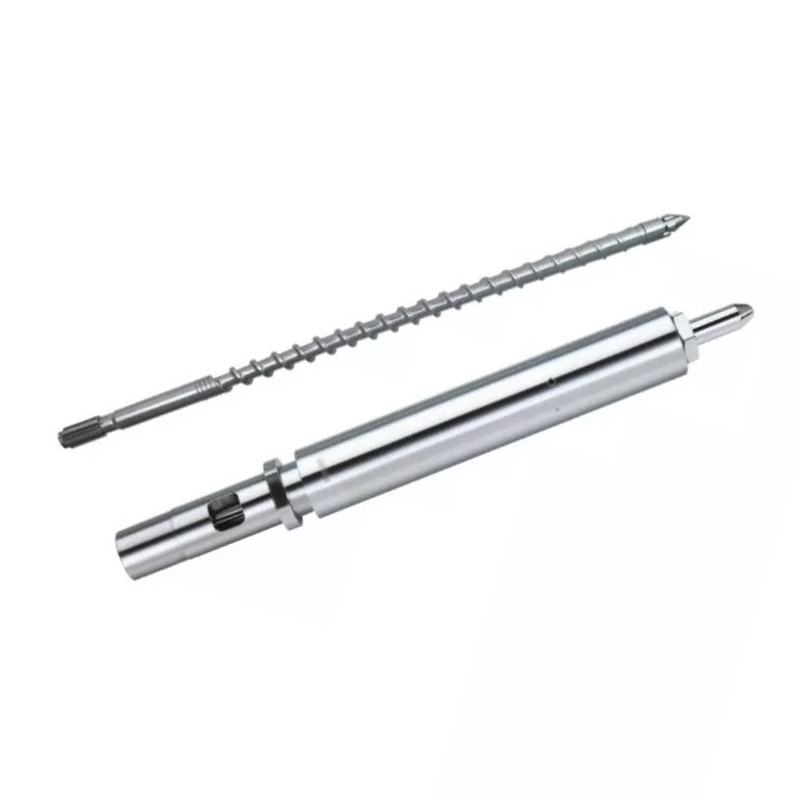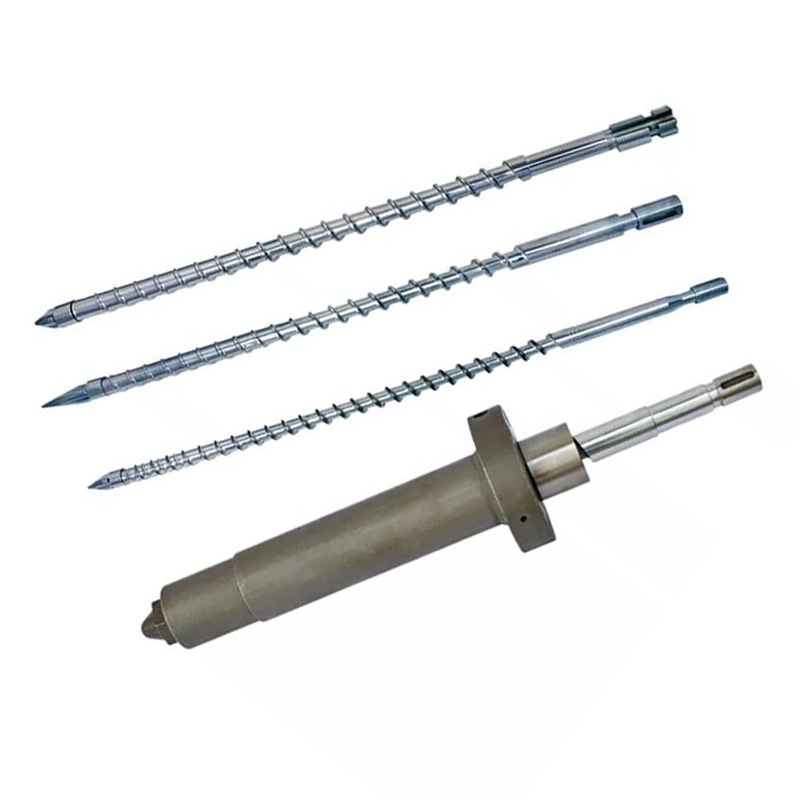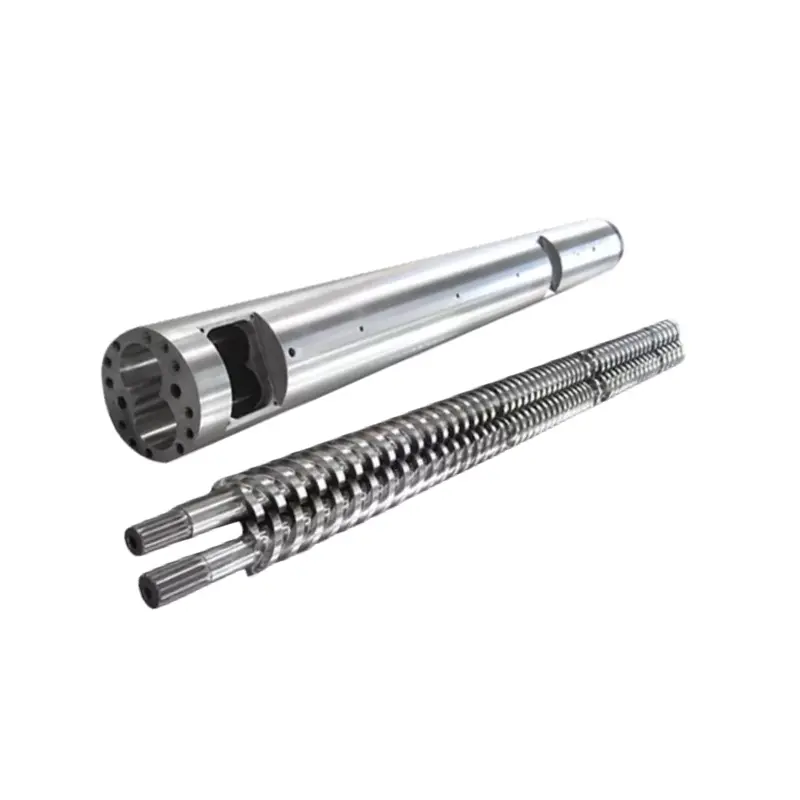

- At a nominal diameter of 65 mm, 30:1 L/D means 1,950 mm of specified working length.
- The same total L/D can contain different zone lengths and perform different processing tasks.
- Additional length must address a demonstrated limitation, not compensate for an unexamined feeding or wear problem.
- Our film-screw range lists 25:1, 28:1, 30:1, 33:1 and 35:1 options; the application determines which option deserves review.
- A longer matched screw-and-barrel assembly is a machine modification, not automatically a drop-in replacement.
What is L/D ratio in a single screw extruder, and how is it calculated?
L/D relates the screw's agreed working length, L, to its nominal diameter, D. Use the same units for both dimensions. The result is dimensionless and is usually written as a ratio, such as 30:1, or as a length designation, such as 30D.
L/D = specified working length / nominal diameter
For a nominal 65 mm screw at 30:1: L = 30 × 65 mm = 1,950 mm.
This is a dimensional example, not a production-capacity calculation.
Agree on where the working length starts and ends
The calculation is simple; the measuring convention needs attention. Allan Griff's explanation of extrusion screw dimensions excludes the portion covered by the feed opening while noting that it is sometimes counted. Dynisco's screw-and-barrel guide describes length from the rear of the hopper to the front of the screw. Those descriptions should not be silently treated as identical.
Request an extruder drawing with both datums marked. Do not substitute the overall shaft length or the screw root diameter. A worn outside-diameter reading also should not redefine the machine's nominal size.
L/D is separate from extrusion screw compression ratio. The former describes length relative to diameter; the latter describes the change in available channel geometry. A quotation needs both the length definition and the actual profile. One headline ratio cannot replace the other.
Short vs long single screws: what changes and what does not?
A higher L/D at the same nominal diameter provides more working length. It does not specify deeper channels, a different compression ratio, a mixing element or a higher rated output. Those are separate design decisions. Compare the profiles before comparing the price of the extra steel.
| Specified L/D | Calculation | Working length | What the number does not establish |
|---|---|---|---|
| 25:1 | 25 × 65 mm | 1,625 mm | Whether melting is complete at the required rate |
| 30:1 | 30 × 65 mm | 1,950 mm | How length is divided between functions |
| 35:1 | 35 × 65 mm | 2,275 mm | Whether the machine can accept the longer assembly |
These calculations use length options listed in our LDPE/HDPE film single-screw range. They do not promise that every diameter, ratio and special feature forms an approved combination. We would confirm the complete specification against the intended application.
For a buyer, the comparison has two sides. More functional space may allow a revised melting or mixing arrangement. It also changes the installation envelope and may add heating, cooling, support and maintenance requirements. A shorter assembly is not automatically gentler or cheaper to operate; its geometry and duty still matter.
Equal L/D does not make different screw diameters equivalent. At 30:1, nominal diameters of 65 mm and 90 mm correspond to working lengths of 1,950 mm and 2,700 mm. That arithmetic proves neither equal capacity nor a reliable scale-up relationship. Keep diameter, drive capability and the proposed screw profile visible in the same comparison.
Where should the extra screw length go?
Specify the job of the additional length before specifying the new L/D. Is it intended to complete melting, provide a dedicated mixing section, accommodate a vent or develop discharge pressure? “Improve performance” is too vague to approve a geometry change.
A conventional plastic extruder screw is commonly discussed in feed, transition and metering sections. Dynisco describes these functions, but a production design can include additional features. A useful drawing labels the relevant sections and shows where each begins and ends.
In profile B, the dedicated mixing section occupies length that profile A assigns elsewhere. It is not free space added to an unchanged 30D layout. If mixing features sit within another named section on an actual drawing, avoid counting that length twice.
Our review would ask what evidence justifies each boundary. A buyer does not need a complete simulation to ask this question. Request the current and proposed profiles on a common axial scale, with retained dimensions identified and each change explained. That makes a meaningful comparison possible even when the two quotations have the same nominal L/D.
When does a higher L/D actually help output?
Additional length is relevant when the current screw lacks functional space for the required processing task. It is a weak first response when the limiting factor has not been identified. Our purchasing recommendation is to name the constraint before choosing a longer extrusion screw.
| Suspected limitation | Evidence to request | Decision before adding length |
|---|---|---|
| Feeding | Feed consistency, particle form, bridging observations and feed-throat conditions | Check material delivery and the extruder feed barrel first |
| Melting or homogeneity | Quality observations at defined output and speed, plus actual melt temperature | Review melting and mixing geometry together |
| Drive capability | Load records and approved motor, gearbox and shaft limits | Confirm available mechanical capacity before promising more output |
| Downstream equipment | Pressure trend, filtration condition and line-speed limitations | Establish whether the extrusion or downstream process sets the ceiling |
Jim Frankland explains in Plastics Technology that feeding can limit the output increase available from a longer screw. His analysis also warns that excess length can create thermal limitations. More processing space is useful only when the whole system can use it.
For the comparison, define good output as material meeting the agreed product criteria, not everything passing through the die. Record rejects separately. A faster run that produces unacceptable melt or product quality does not meet the same production requirement.
We would keep material condition, measurement method and trial sequence documented. If several operating settings change along with the screw, the result belongs to the complete change package. It should not be credited solely to L/D. This distinction helps buyers judge a proposal without asking a simple dimension to explain every improvement.
L/D, residence time and melt temperature: avoid a false shortcut
L/D is a geometric ratio, not a stopwatch. Changing from 24:1 to 36:1 increases the specified length by 50% at a fixed diameter. It does not establish that every portion of material spends 50% longer inside the barrel. Geometry, material inventory, throughput and flow behavior also enter the comparison.
Dynisco's discussion of barrel residence time relates degradation to both temperature and exposure time. That is why a length decision should include the actual operating range, rather than only the maximum-output point.
Compare the operating window, not one steady-state reading
We would request records at the intended production rate and at a realistic lower rate. Include the material grade, screw speed, output, drive load, pressure, barrel settings and measured melt temperature. Use an agreed sensor location and method. Barrel setpoints and measured melt temperature must remain separate fields in the report.
Also discuss startup, interruptions and changeovers. A profile that performs acceptably at the main production setting still needs an agreed operating procedure when the line slows. Define which product-quality observations matter, such as color change or unmelted particles, without assuming that any one symptom proves excessive residence time.
If residence-time measurement is needed, agree on a suitable method with the processor and equipment specialists. Do not estimate it from L/D alone or introduce a tracer without considering compatibility, contamination and plant procedures.
Our decision rule is to approve a length change against an operating window with defined quality limits. A single impressive output figure is insufficient when the intended line must also run slower products or frequent material changes.
Choosing a plastic extruder screw L/D ratio for your application
Start with the actual feedstock, finished product and process arrangement. A polymer name alone does not specify particle form, recycled content, additives, melting demand or the quality standard. Our product details show why length should be reviewed with the rest of the design.
| Application | What our product information specifies | What we would review with the buyer |
|---|---|---|
| LDPE/HDPE film | L/D options of 25:1, 28:1, 30:1, 33:1 and 35:1; forced-feeding bimetallic configuration is an option | Feed behavior, formulation, film-quality requirements and the function assigned to extra length |
| Transparent granulation | Longer L/D combined with lower rotational speeds, milder shear and smooth flow transitions | The complete flow path and thermal duty, rather than a larger ratio in isolation |
| Abrasive or filled feedstock | Wear-resistant material and working-surface options for duties including glass fiber and mineral-filled materials | Wear location, formulation and matching barrel condition before choosing geometry or surface treatment |
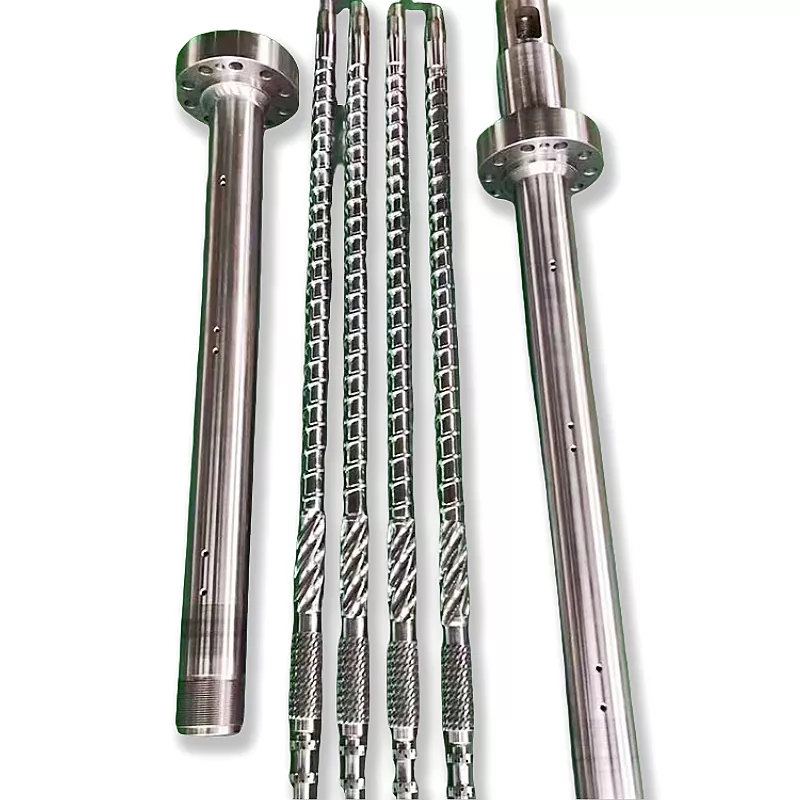
These are application-specific facts, not a universal material-to-L/D chart. We would not assign one ratio to all PE grades or copy a general specification table into a dedicated transparent-material recommendation.
Recycled feedstock also needs a precise description. Ask about feed form, consistency, contamination control and filtration. “Recycled” does not, by itself, justify a short screw, a long screw or a particular vent arrangement. The quotation should connect each selected feature to a defined requirement.
For buyers comparing extruder screws and barrels, this approach is more useful than ranking quotations by the largest ratio. It also identifies which questions the supplier still needs to answer before manufacture.
Barrier, mixing and vented screws need a function-based length review
Special features change how the working length is used. A barrier section, a dedicated mixer and a vented two-stage arrangement should not be treated as interchangeable additions to a conventional profile. Ask where the feature sits, what enters it and what processing task follows it.
Barrier and mixing features
For a barrier design, request the barrier-section boundaries and the relevant channel and flight dimensions. For a mixer, request its geometry and location. Our guide to barrier, conventional and mixing screws addresses those design choices. L/D provides an overall length reference, not a substitute for them.
Vented two-stage designs
A vented assembly needs room for decompression and subsequent pumping. Frankland's published L/D comparison notes that roughly 4D to 6D can be occupied by the vent area. He gives a 30:1 two-stage versus 24:1 single-stage comparison for matching output in most applications under discussion.
That is an explanation of how a vent consumes working space, not a universal conversion rule or a Nanhaiya production result. A proposed vented profile still needs the feedstock, vent duty, pressure requirement and intended output defined. Equal total length does not mean equal length remains available for melting and pumping.
A melt pump changes the pressure-development duty assigned to the screw, as Frankland also discusses. It does not remove the need for suitable melting upstream. Our recommendation is to redraw the functional allocation when venting or pumping equipment changes, rather than carry the previous L/D across without review.
Can you increase L/D by replacing the extruder screw and barrel?
Sometimes a longer matched assembly is feasible, but nominal diameter does not establish compatibility. Separate three proposals: a revised profile within the existing envelope, a like-for-like replacement, and an extension of the processing assembly. Their engineering and installation scopes differ.
Rule out wear before changing screw length
If an established line has gradually lost performance, inspect the existing parts before treating its original L/D as the cause. Our screw-and-barrel wear measurement guide explains corresponding screw-diameter and barrel-bore checks. Record the measurement locations and compare them with the approved reference dimensions.
A longer new screw in an unsuitable existing barrel does not resolve the matching problem. For an extension proposal, review the barrel arrangement, interfaces, support, heating and cooling, drive limits and removal space with the machine owner or original equipment supplier.
How we would evaluate a 65 mm film-screw length change
Using the L/D options in our film-screw range, consider a nominal 65 mm screw as a dimensional example. At 30:1, its specified working length would be 1,950 mm. At 35:1, that length would become 2,275 mm. The proposed change therefore adds 325 mm of working length.
Our first question would be what those additional 325 mm must do. If the purpose is improved melting at a higher production rate, we would request evidence of the current melting limitation and a drawing showing how the proposed profile addresses it. If the purpose is better additive distribution, we would examine the mixing geometry and its location rather than assume that longer conventional flights will solve the problem.
We would also separate a screw redesign from a machine extension. The longer profile would require a compatible barrel arrangement, heating and cooling layout, support and connection details, and sufficient maintenance space. Diameter alone cannot establish compatibility.
With only the diameter, two L/D values and a complaint of low output, our decision would be to hold the extension proposal pending that review. We would compare retaining the current length with revised geometry against specifying a longer matched assembly.
The calculation establishes a 325 mm increase in working length. It does not establish a production gain. Approval would depend on a defined function for that length, confirmed machine compatibility and an agreed trial comparing good output, melt temperature, pressure stability and drive load.
What an extruder drawing must show before we approve screw length
How we review screw length before changing the design
When we review a screw-length requirement, we start with the production problem rather than the requested L/D. A specification such as “65 mm, 35:1” tells us the nominal diameter and intended working length, but it does not explain what the additional length needs to accomplish.
If a film line develops unstable output, our first step would be to establish whether the problem appeared after a material change, a higher production target or gradual component wear. We would request the current screw drawing, matching barrel dimensions and operating records before recommending a longer assembly. A feeding problem and a melting limitation require different responses.
Our LDPE/HDPE film screw range includes L/D options of 25:1, 28:1, 30:1, 33:1 and 35:1. We would compare those options against the formulation and machine conditions. The longest option should earn its place through a defined processing requirement.
The drawing then needs closer attention. We would mark the working-length datums and identify the space assigned to feeding, melting, mixing and metering. If a proposal adds length, we want to know which section changes and why. Extending an existing profile without explaining that change leaves the buyer with a larger component but an unresolved production question.
For transparent granulation, our application-specific design combines longer L/D with lower rotational speeds, milder shear and smooth flow transitions. We would review these features together rather than treating length as an independent improvement.
Before approving manufacture, we would agree on retained dimensions, revised geometry and installation interfaces. The production comparison should use defined material and operating conditions, with acceptable melt quality and good output recorded together. We would recommend additional length only when the proposal explains its purpose, fits the machine and provides a measurable basis for judging the result.
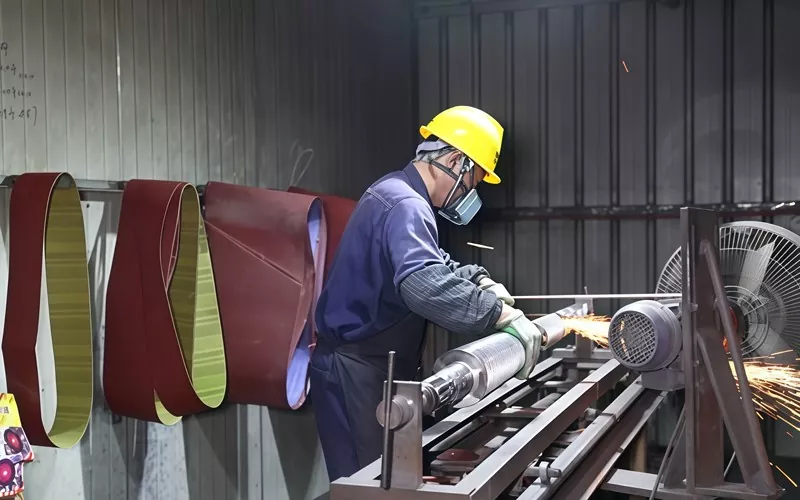
A six-step length-selection review
- Define the duty. Supply the resin grade, feed form, additives, finished product, quality requirements and target good-output rate.
- Confirm the geometry. Mark nominal diameter, working-length datums, overall mechanical length, zone boundaries, channel depths and special features on the current drawing.
- Establish the baseline. Record material condition, speed, output, melt temperature, pressure, drive load and matching screw-and-barrel wear measurements where applicable.
- Assign a purpose to the change. Compare retained-length and longer-profile proposals, identifying which function each revised section serves.
- Check machine compatibility. Confirm barrel and drive interfaces, support, heating and cooling, approved equipment limits and maintenance access.
- Agree on acceptance. Define dimensional inspection and a production trial with consistent material, measurement methods and product-quality criteria before approving manufacture.
The deliverable from this review should be a dimensioned proposal with a stated reason for each change. It gives purchasing, production and the component manufacturer the same basis for approval.
Discuss the length your process actually needs
Send your current screw and barrel drawings, material details and operating records to Zhoushan Nanhaiya Plastic Machinery Co., Ltd. Our technical service covers application and equipment-based screw selection.
Discuss your screw-and-barrel project
Email: info@nhyscrew.com
Phone / WhatsApp: +86 135 0580 9643
Frequently asked questions about single screw extruder L/D
What does 30:1 L/D mean on a single screw extruder?
It means the specified working length is thirty times the nominal screw diameter. For a nominal 65 mm screw, that is 1,950 mm. Confirm the start and end datums on the drawing; overall mechanical length, including the drive shank, is a different dimension.
Does a longer single screw always produce more good output?
No. Additional length can help when it provides functional space that the process needs. It does not remove feeding, drive or downstream limitations. Compare output that meets the agreed product criteria alongside melt temperature, pressure behavior and drive load under defined operating conditions.
How is L/D different from compression ratio?
L/D compares working length with nominal diameter. Compression ratio compares feed and metering channel geometry; the channel-depth ratio is a common expression for conventional equal-lead profiles. A screw can change length without changing that ratio, or change its channel profile while keeping the same total length.
Can two screws with the same L/D perform differently?
Yes. Their zone lengths, channel depths, pitch, barrier or mixing features and matching barrel arrangement can differ. The same L/D does not even establish the same absolute working length unless nominal diameter also matches. Compare dimensioned profiles and operating conditions rather than the ratio alone.
Can I install a longer screw in my existing barrel?
Not on diameter information alone. A longer working profile needs a compatible barrel arrangement and confirmed mechanical interfaces. Review support, heating and cooling, drive limits and maintenance access. A redesign within the existing envelope is a different proposal from extending the complete processing assembly.
Why can vented and non-vented screws require different lengths?
A vented two-stage screw uses part of its working length for decompression and vapor removal before subsequent pressure development. That changes the space available for the other functions. Review vent duty and zone allocation rather than treating equal total L/D as proof of equivalent processing capability.