
The best extruder screw is the one that solves your line’s limiting task: feeding, melting, mixing, venting, or pumping against die pressure. Begin with the resin and feed form, then diagnose the actual bottleneck before selecting a conventional, barrier, mixing, or vented design. A screw that improves one task can make another worse, so the machine, barrel, die, and acceptance test must be specified together.
- Identify the feed: virgin pellets, powder, regrind, flake, filled compound, or a changing blend.
- Measure the failure: solids at the die, color variation, pressure instability, trapped volatiles, wear, or insufficient output.
- Match the screw feature to that failure instead of choosing the most elaborate geometry by default.
- Check barrel condition, drive capacity, heating, screen pack, and die restriction before approving the design.
- Agree on comparable trial conditions and the measurements that will count as acceptance.
Start with the job your extruder screw must perform
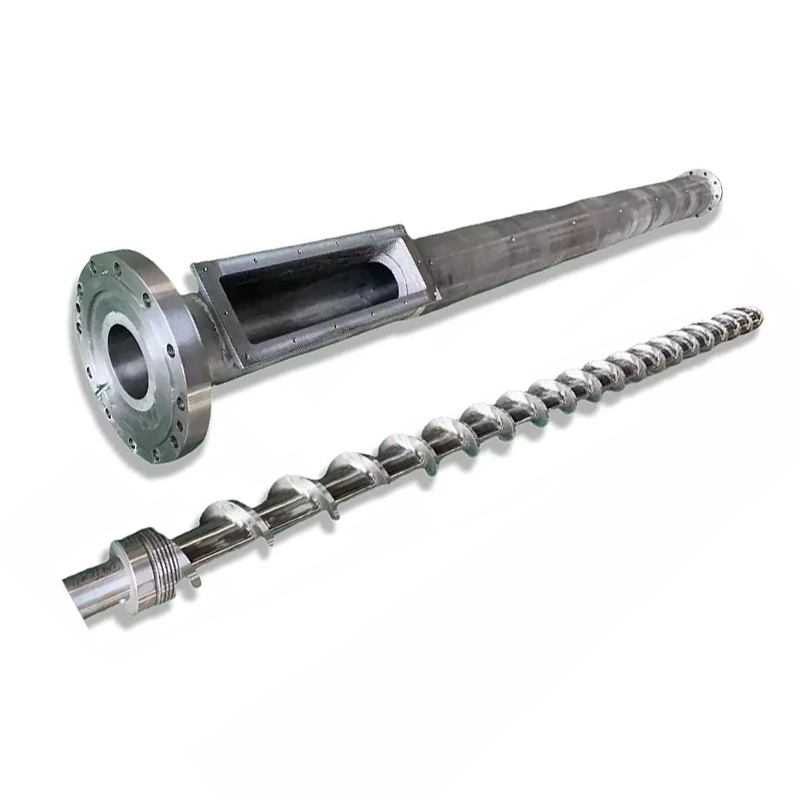
Our single-screw product range separates film, aluminum-plastic panels, transparent granulation and wear-intensive feed because those applications put different demands on the component. A film line needs melt delivery suited to the film specification. A panel core also needs colorants and flame retardants distributed through the melt. A transparent pellet adds strict demands on retained material and contamination.
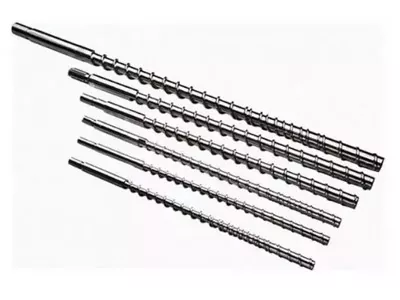
Those differences appear in the product designs. Our film screw offers several diameters and L/D options, while our panel screw combines a barrier-type mixing section with polished channels. Our transparent-granulation design emphasizes smooth head transitions and continuous flow paths.
Begin the selection with the product defect or process limit. If the feed is fully plasticized but color varies, review mixing and dosing. If unmelted material remains at the required output, review melting. If filled resin removes metal from the flights, specify the working surface as well as the geometry. These are different decisions even when the nominal screw diameter matches.
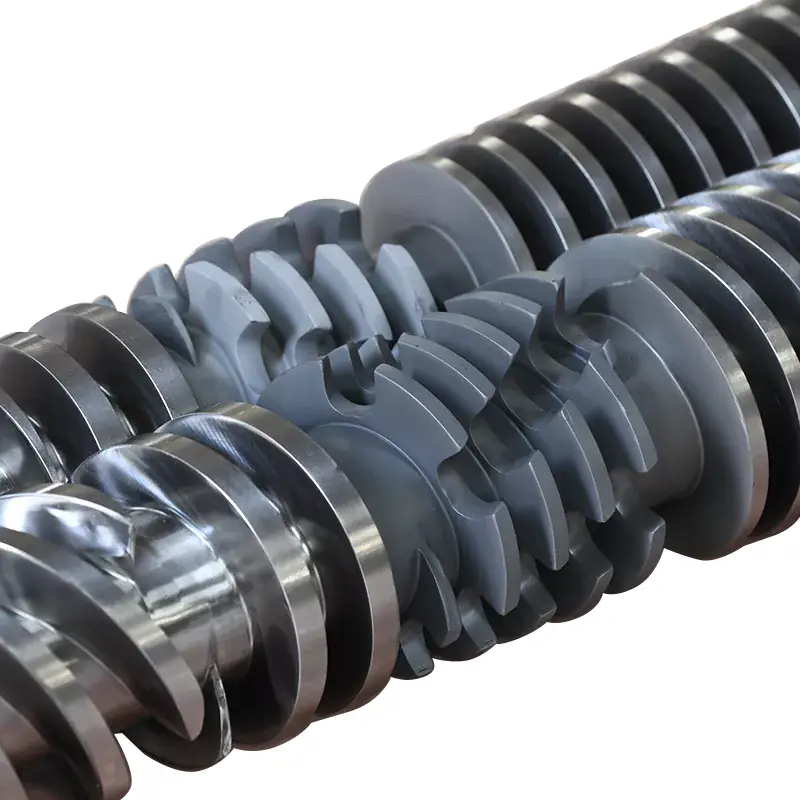
A conventional screw uses feed, transition and metering zones. Barrier and mixing features alter how it performs particular tasks. Original research comparing conventional and barrier designs shows why the resin and optimization objective matter: the studied barrier designs were generally advantageous for LDPE, while either type could be feasible in the selected PP cases.
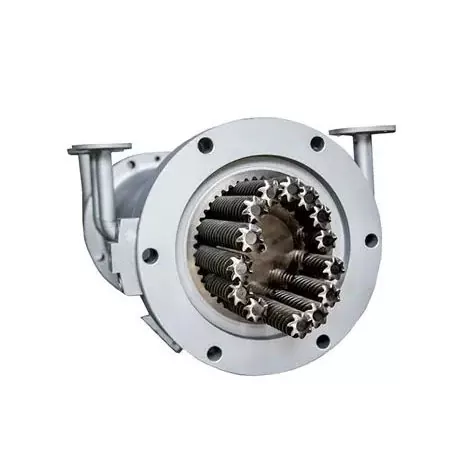
Here we focus on choosing the screw component for an extrusion line. For a machine-architecture decision, compare our single-screw, parallel twin-screw and conical twin-screw product families before specifying a replacement component.
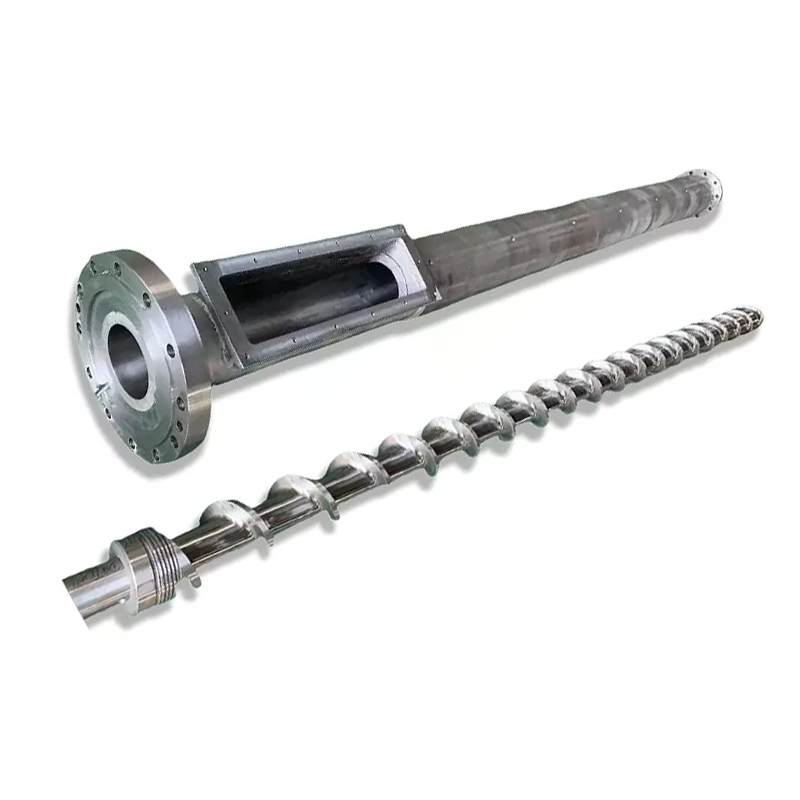
Conventional, barrier, mixing, and vented designs: a decision table
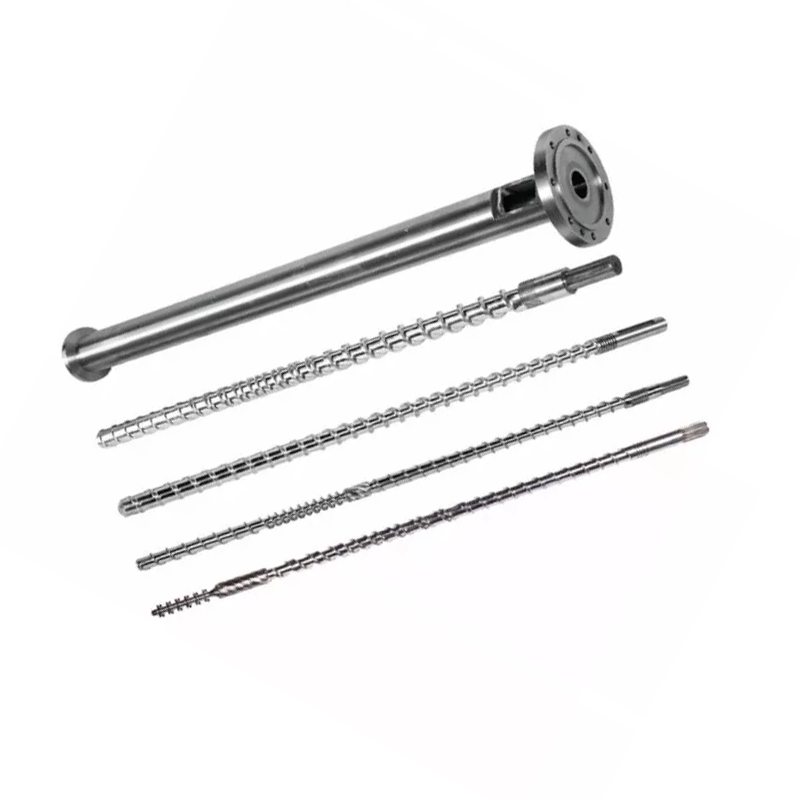
“Screw type” is useful shorthand, not a complete engineering specification. A conventional screw can include an added mixer; a barrier section may lead into a mixing section; a vented line also needs upstream melt preparation and downstream pressure rebuilding. Select the functional feature only after you know what the melt is failing to do. Nanhaiya’s existing design comparison explains the melt path of conventional, barrier, and mixing screws; the table below turns that knowledge into a purchasing decision.
| Design starting point | Job it is meant to solve | Useful evidence before choosing it | Trade-off to check |
|---|---|---|---|
| Conventional three-zone screw | Convey, melt, and meter a relatively consistent feed | Stable feed rate, acceptable melt uniformity, and no chronic unmelted particles | May not supply enough melting or distribution when output or formulation demands rise |
| Barrier section | Manage the path of solids and melt during transition | Persistent unmelted material or temperature spread at the required rate | Geometry must still suit resin, throughput, barrel, and pressure demand |
| Mixing element | Redistribute melt or break up poorly dispersed material, depending on element design | Color streaks, additive variation, or measured melt-temperature nonuniformity | Extra shear, pressure drop, residence time, or cleaning difficulty may matter |
| Vented or devolatilizing arrangement | Release air or volatiles after sufficient upstream melting | Entrained gas, moisture or volatile symptoms confirmed in the feed and product | Feed rate, vent flooding, vacuum system, and downstream pumping must be assessed together |
A mixing section is not a cure for poor feeding. A barrier flight will not restore a worn barrel bore. A vent does not excuse skipping the material supplier’s drying instructions. Treat each row as a design hypothesis to test against the failure record, not as a promise that one named screw will always outperform another.
Nanhaiya’s aluminum-plastic panel single screw illustrates why the categories overlap: its published description combines barrier-type melting with mixing for colorants and flame retardants. That page is a product example, not a universal recommendation for every sheet or panel line. Its intended resin, formulation, die, and actual operating window still have to match the buyer’s duty.
Match the screw to the material and finished product
LDPE, LLDPE and HDPE film
Our film single-screw page identifies packaging, agricultural, shrink/stretch and heavy-packaging film applications. Its listed diameter range runs from 30 to 150 mm, with L/D choices of 25:1, 28:1, 30:1, 33:1 and 35:1. The choice should follow the formulation, required output and film-quality target.
For this duty, we would ask for the resin blend, recycled fraction, film thickness and current melt-pressure behavior. The product details also describe bimetallic forced-feeding construction. Specify whether the limiting task is feed transport, complete melting or pressure delivery; the same film defect can have causes elsewhere in the line.
Aluminum-plastic panel cores
Our panel screw uses a barrier-type mixing section for melt uniformity and distribution of colorants, flame retardants and other additives. Its production details identify polished flow channels and a torpedo-shaped or rounded head to reduce retention points. Common panel-duty diameters include 65, 90, 120 and 150 mm.
We would separate uneven core color from black-speck formation before changing the design. Color variation directs attention to dosing and mixing. Repeated black specks also require a flow-path and cleaning review. Request the head transition and channel finish on the drawing so those features survive a replacement order.
Transparent granulation and color changes
Our transparent-granulation screw combines 38CrMoAlA nitrided steel with smooth transitions, continuous grooves and surface-treatment options. Its application-specific production details describe a 2.0:1–2.5:1 compression ratio, a longer L/D and lower-speed operation with milder shear. These features put material quality alongside output in the selection.
For transparent resin, include black-speck limits, discoloration and changeover behavior in the project brief. Examine where material can remain around the head and groove transitions. A screw that reaches the desired kg/h while leaving visible contamination has not met this product's purpose.
Glass-fiber, mineral-filled and recycled feed
Our wear-resistant range covers glass-fiber plastics, calcium carbonate, talc, recycled feed and corrosive materials. It offers several steel substrates, nitriding and local or coated alloy protection. The first purchasing question is where metal is being lost and which formulation is causing that duty.
Send the filler type and percentage, recycled fraction and paired screw/barrel measurements. The geometry still needs to melt and convey the feed, while the surface construction addresses wear. Specify the two together, rather than assuming that a harder surface selects the correct melting profile.
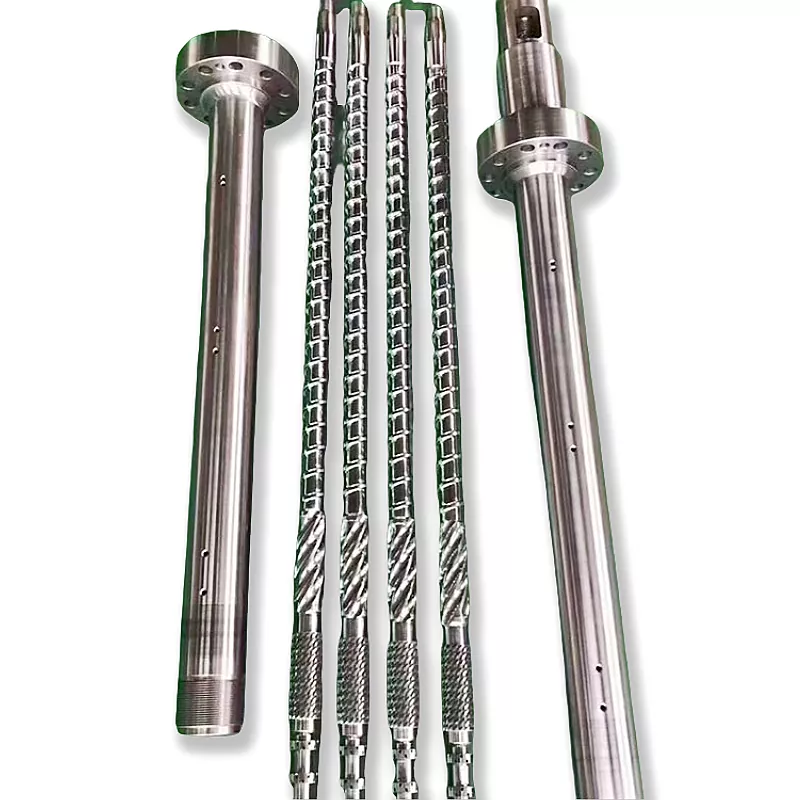
Inside the barrel: the geometry and measurements that matter
A good selection discussion moves past names and into dimensions. Nominal diameter establishes the size class and machine fit. Working length divided by screw diameter gives the L/D ratio; it describes available process length, not a standalone quality score. Feed-channel and metering-channel depths, pitch, flight width, transition length, and any barrier or mixing element together influence solids transport, melting, shear, and pressure generation. Two screws with the same L/D can perform differently because the rest of that geometry differs.
Compression ratio also needs a definition on the drawing. For a conventional constant-pitch screw it is commonly discussed as feed-channel depth divided by metering-channel depth. That shorthand becomes less informative when pitch, barrier geometry, or specialized sections change. State the dimensions and their measurement locations rather than ordering “a 3:1 screw” and assuming every supplier will interpret the phrase the same way. Specify which surface is being protected, too: a nitrided base screw and a locally hardfaced flight are different constructions, even when their nominal diameter matches.
The barrel and die set the conditions under which that geometry works. A worn bore increases leakage over the flights; a restrictive screen pack or die raises the pressure the screw must develop. To separate an equipment problem from a material problem, record screw speed, actual melt temperature, pressure before and after the screen where sensors exist, output by mass, motor load, and product defects under a stable recipe. Nanhaiya’s single-screw wear-measurement guide explains why screw and bore measurements must refer to the same axial stations and a controlled drawing.
Melt flow rate is useful incoming-material information, but it is not a line-output guarantee. ISO 1133-1:2022 defines MFR and MVR tests at specified temperature and load, and explicitly notes that their shear rates are much lower than ordinary processing conditions. ASTM D1238-26 likewise describes melt flow as an empirical quality-control measure that may not correlate directly with large-scale process behavior. Record the test condition with the result, then verify the material on the actual line.
Diagnose the line before you redesign the screw
Starting from the symptom keeps a buying decision honest. “Low output” is not a screw specification. A starved hopper, drifting feeder, clogged screen, undersized drive, worn barrel, or unsuitable die can all reduce output. “Black specks” are equally ambiguous: incoming contamination, retained polymer, a damaged flow surface, excessive thermal history, or a dirty downstream component may be involved. Nanhaiya’s own black-line diagnostic article recommends investigating material, cleaning, and equipment in sequence.
| What you observe | Check before changing screw type | Screw-design question if the basics are sound |
|---|---|---|
| Unmelted pellets or gels | Resin lot, rate, actual melt temperature, heater control, screen condition | Does the transition section provide enough melting at required throughput? |
| Color streaks or additive variation | Premix, feeder calibration, masterbatch compatibility, filter condition | Would a suitable distributive or dispersive feature improve the specified product measure? |
| Pressure or output surging | Feed stability, vent behavior, screen differential, die restriction, screw/barrel wear | Is the present channel geometry mismatched to feed form or pumping duty? |
| Bubbles or trapped volatiles | Drying, incoming moisture, contamination, vacuum system | Would a properly designed vented arrangement help after upstream causes are controlled? |
| Falling output over time at similar settings | Matched screw-flight and barrel-bore measurements | Is repair or replacement needed before a redesign is justified? |
Change one causal variable at a time during a line trial. If both resin and screw geometry change together, a better surface finish cannot be attributed to the screw. If output increases only because screw speed and melt temperature also rise, record the additional heat and motor demand. For a fuller process diagnostic, use Nanhaiya’s surging guide and its screw-speed, melt-temperature, and output guide before locking the RFQ.
Product specifications that change the selection
The useful part of a specification is the decision it controls. Diameter sets a size class; L/D defines process length under the drawing's definition; a compression ratio describes a channel relationship; a surface process protects selected metal. Our application pages let buyers separate those decisions before a quotation combines them.
| Nanhaiya product | Specific design or option | How to use it in selection |
|---|---|---|
| Film single screw | 30–150 mm diameters; L/D 25:1, 28:1, 30:1, 33:1, 35:1 | Match formulation and output to the available barrel and machine envelope |
| Panel single screw | Barrier-type mixing; polished channels; rounded or torpedo-shaped head | Review melting, additive distribution and retention points together |
| Transparent-granulation screw | Application-specific compression ratio 2.0:1–2.5:1; smooth head transitions | Discuss plasticization, thermal history and clean changeovers for the actual transparent material |
| Wear-resistant screw | PTA on flight tops and sides; ion nitriding up to HV1000–1200 | Identify the wear location and select a process-specific inspection requirement |
Two screws can therefore share a diameter while differing in both process behavior and construction. A film profile selected for a stable pellet blend is a different proposal from a transparent-granulation profile focused on retention and thermal history. Adding a wear-resistant treatment changes another part of the specification without defining the melting geometry.
For the mating barrel, our extruder screw-and-barrel details describe nickel-based/tungsten alloy construction with 2–3 mm alloy depth and HRC58–65 hardness. Keep the component and treated location explicit on the order. Screw-surface and barrel-liner requirements need their own inspection entries.
Use laboratory flow data as supporting material information. ISO 1133-1:2022 defines the test temperature and load for MFR/MVR and notes the difference from processing shear rates. A material with an acceptable laboratory result still needs to be evaluated with the proposed geometry, die and finished-product criterion.
Our factory review starts with a product-specific decision
When a brief says “improve output,” we would first put the finished product beside that request. On a film line, the result needs acceptable gauge, appearance and strength. On a panel-core line, additive distribution matters. On transparent granulation, visible contamination can reject the material even when throughput is satisfactory.
We would then mark the corresponding features on the drawing: the feed arrangement and L/D for a film duty, the mixing section and polished flow path for a panel duty, or the transition details for transparent material. Our pre-sales process includes requirement diagnosis and matching diameter, L/D, groove depth and material selection.
For a worn component, we would compare the original drawing with the measured screw and barrel. Wear measurements establish the present condition; they do not automatically recover the original dimensions. Agree which features are being copied, restored or changed before manufacturing starts. That avoids combining a replacement job and a redesign without a clear approval.
Our equipment page describes CNC lathes for workpieces up to 6 m, drilling/milling equipment and five-axis machining for irregular flights and flange structures. Those capabilities support custom geometry. The drawing must identify the actual tolerances and measurement points for the finished component.
Before approving the order, we would ask what production result closes the project. For color distribution, define the sampling and comparison method. For a wear-resistant construction, record baseline dimensions and an inspection interval. For a melting problem, compare accepted output with melt temperature, pressure and motor load under the same material conditions.
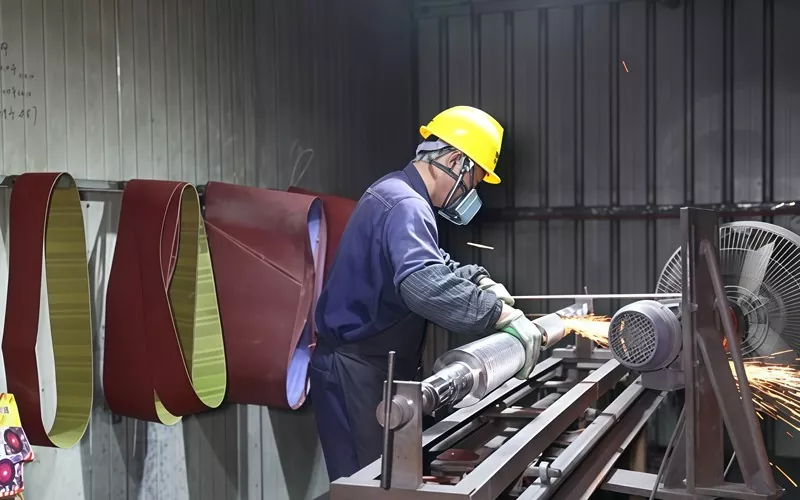
A practical selection sequence for the next screw project
The order of decisions matters more than the number of features on a drawing. Start with a stable baseline, identify one limiting task, and specify the least complicated geometry that addresses it. That approach leaves room to add a barrier, mixer, vent, or wear-resistant surface when the evidence warrants it; it also prevents the common mistake of treating a geometric upgrade as a cure for unstable feed or a damaged barrel.
- Freeze the material description. Record grade, form, additives, filler content, recycled fraction, and drying or handling conditions. Include the supplier’s processing guidance and the actual production recipe.
- Establish the current line baseline. Run a representative lot and log mass output, screw speed, melt temperature, pressure, motor load, screen differential where available, and product quality. Retain samples and note the time of each reading.
- Separate process faults from component wear. Check feeder operation, barrel heaters, screen pack, die, and matching screw/barrel measurements. Follow the machine maker’s service procedure before any inspection or removal.
- Name the limiting screw task. Is the target stronger solids transport, more complete melting, better distribution, volatile removal, or pressure stability? Write one primary objective and the quality measures it may affect.
- Review candidate geometries and surfaces together. Compare the existing drawing with a proposed conventional, barrier, mixing, or vented arrangement. Check machine fit, drive capacity, temperature sensitivity, material wear, and cleaning requirements.
- Define acceptance before manufacture. Put drawing tolerances and line-test conditions in writing. Compare the new part with the baseline on a comparable material lot and report both improvements and new trade-offs.
What a useful screw RFQ should include—and what “cost” really means
A request for quotation that contains only screw diameter invites a quote for a shape, not for the production problem. Send the screw drawing or a clearly identified sample; barrel drawing and bore condition; machine make and model; resin recipe and feed form; current and target output; product quality limits; and present operating observations. Mark whether the part must replicate an approved design, correct a known defect, or support a new material. Those are different orders, even if the drive-end dimensions are identical.
For the drawing, clarify nominal diameter, overall and working length, L/D definition, channel depths, pitch, flight width, transition location, mixing or barrier details, tip geometry, drive connection, handedness, surface treatment, and inspection datums. Where a dimension is measured from a worn screw, identify it as an observation rather than an approved nominal value. If the barrel is worn, ask whether a new screw alone can meet the specified clearance; Nanhaiya’s screw-only versus matched-pair guide discusses that decision.
Compare bids on more than purchase price. The relevant cost includes replacement scope, downtime for fit-up, inspection effort, possible rework, cleaning time, and the value of stable product quality. Avoid inventing a payback period: calculate it from your own lost output, scrap, maintenance hours, and quoted alternatives. Nanhaiya’s service page says its pre-sales support includes parameter matching and a quote covering product, shipping, and estimated maintenance considerations. Ask for those items to be identified in the offer, along with the approved drawing revision and contractual acceptance terms.
Talk to Nanhaiya about your extrusion duty
Zhoushan Nanhaiya Plastic Machinery Co., Ltd. publishes single-screw products for pipe, film, panel, granulation, and wear-intensive applications. Its production-equipment page describes CNC turning, drilling/milling, and five-axis capability; the service page describes material, machine, capacity, and parameter review before a tailored quotation. Use the application-specific product details to begin the review, then send the drawings and production record for your line.
Send the material grade, product, machine model, screw and barrel drawings, present symptoms, and target output. If you have an existing screw, add clear photos and a wear map. For a new design, explain the feed form, additives, die, and quality criterion that matters most. We can then discuss whether the real job calls for a conventional profile, a melting-focused barrier section, a mixing feature, different surface protection, or a matched screw-and-barrel review.
For an actionable recommendation, tell us which constraints cannot change: barrel size, gearbox, drive-end connection, heater layout, available motor power, and downstream equipment. Also tell us which outcomes can be tested at your plant. A proposal built around a fixed machine envelope is different from a clean-sheet line design, and that distinction should be clear before anyone approves the manufacturing drawing. Your project should receive a proposed geometry, material construction, and inspection plan tied to those constraints—not a stock promise of more output from a new screw.
Send your screw project details
Contact: info@nhyscrew.com · +86 135 0580 9643
Block C, No. 2 West Section, Xingzhou Avenue, Dinghai District, Zhoushan City, Zhejiang Province, China. Source: Nanhaiya contact page.
Frequently asked questions
What are the main types of extruder screws?
For a single-screw plastics line, conventional three-zone, barrier, mixing, and vented arrangements are useful functional starting points. They are not exclusive categories: one screw may combine a barrier section with a downstream mixer. Select the feature according to the feed, defect, and measured line constraint, not the label alone.
Is a barrier screw always better than a conventional screw?
No. A barrier section can help manage solids and melt during the transition when melting is the limiting task, but a conventional profile may already meet the required output and quality. The proposed design still needs to fit the resin, barrel, pressure demand, and target operating window. Compare under controlled conditions.
When should I add a mixing element?
Consider it when measured melt-temperature variation, color streaking, or additive distribution remains a problem after feed preparation and process controls are checked. Ask what kind of mixing is needed and what pressure, shear, residence-time, and cleaning penalties the element may introduce. A mixer cannot repair a worn barrel.
Can I select the screw from melt flow rate alone?
No. MFR or MVR can help compare material lots under stated test conditions, but it does not reproduce every shear and pressure condition in production. Use the exact grade, material supplier guidance, formulation, line data, and a representative trial. ISO 1133-1:2022 explicitly notes the limitation.
What should I send for a replacement screw quotation?
Send the machine model, approved screw and barrel drawings or identified samples, resin and additives, target output, present operating data, defect photos, and screw/barrel wear readings if available. State whether you need an exact replacement or a redesigned component and agree on inspection and line-acceptance criteria before manufacture.