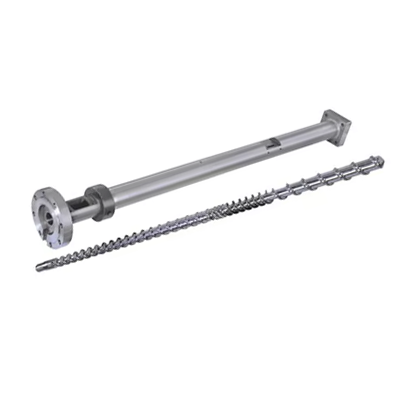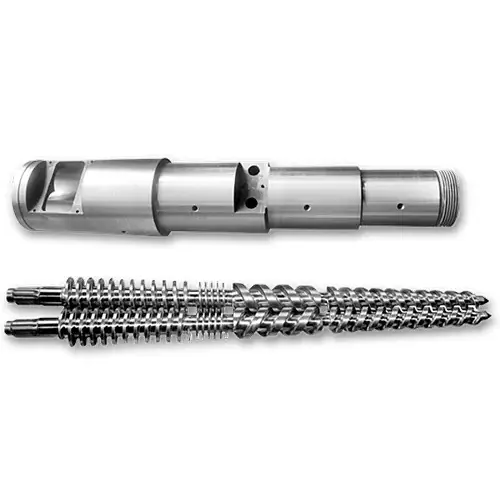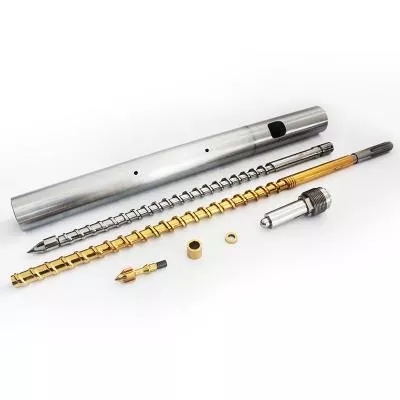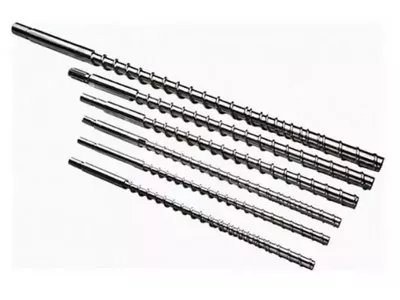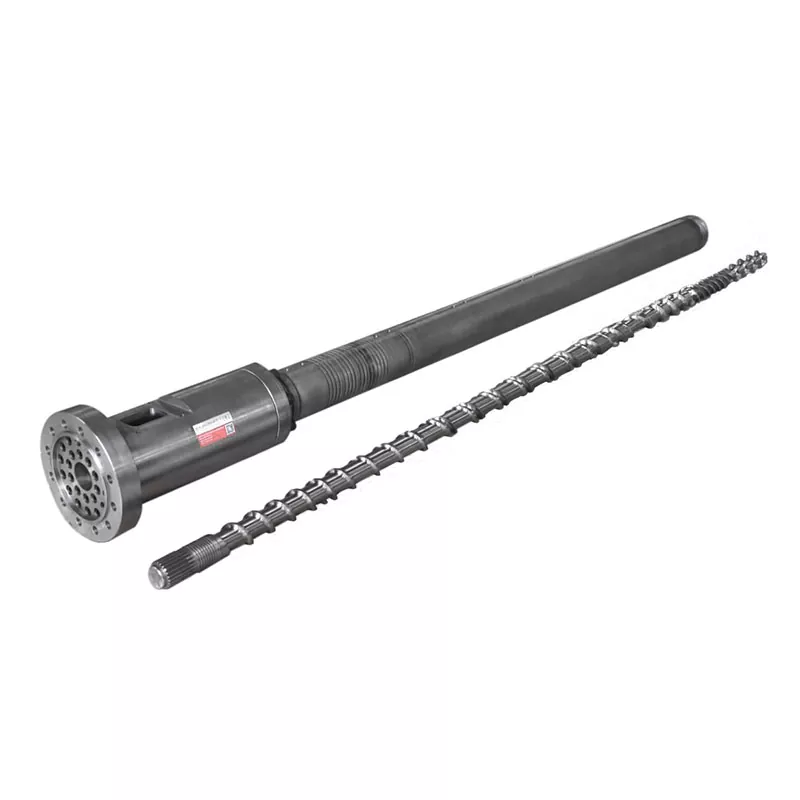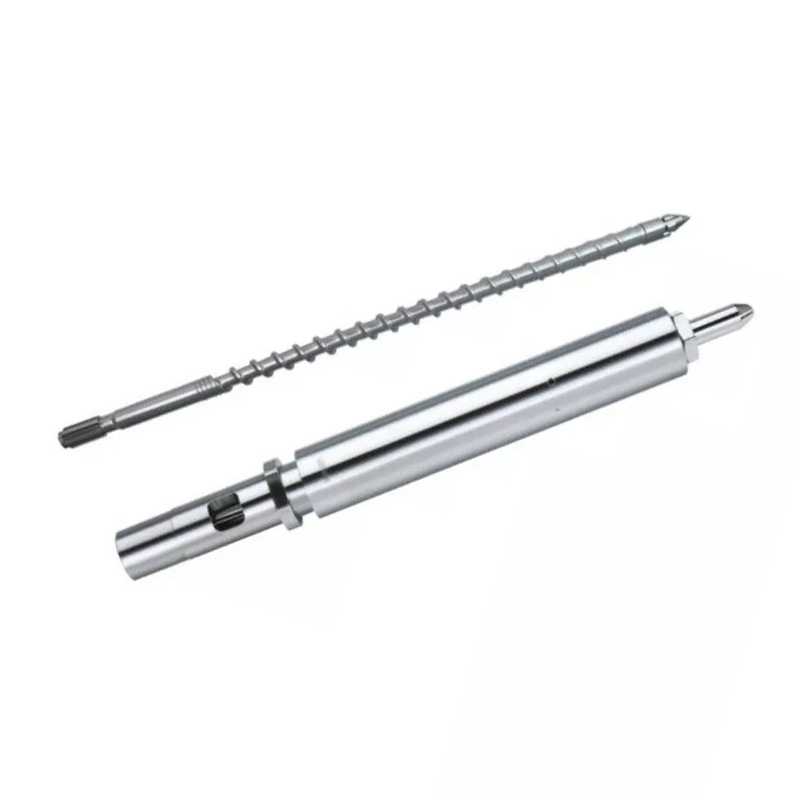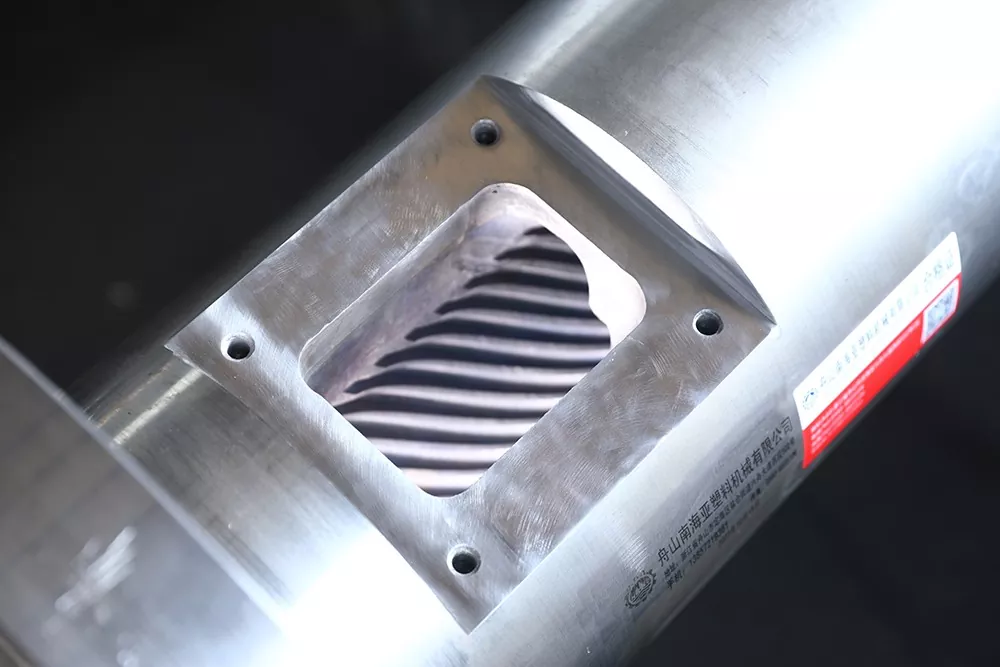

Injection screw L/D ratio is working length divided by screw diameter, and most injection screws run 18:1 to 25:1. Here is what no spec sheet tells you: you cannot change L/D on a machine you already own. The length is fixed by the barrel. What you can change is screw diameter, and in a fixed barrel that one choice moves L/D, shot capacity, and injection pressure together, in opposite directions. A smaller screw gives a higher L/D, a smaller shot, and more pressure. Match that trade to your resin and your part, and most L/D questions answer themselves.
What L/D Ratio Means on an Injection Screw
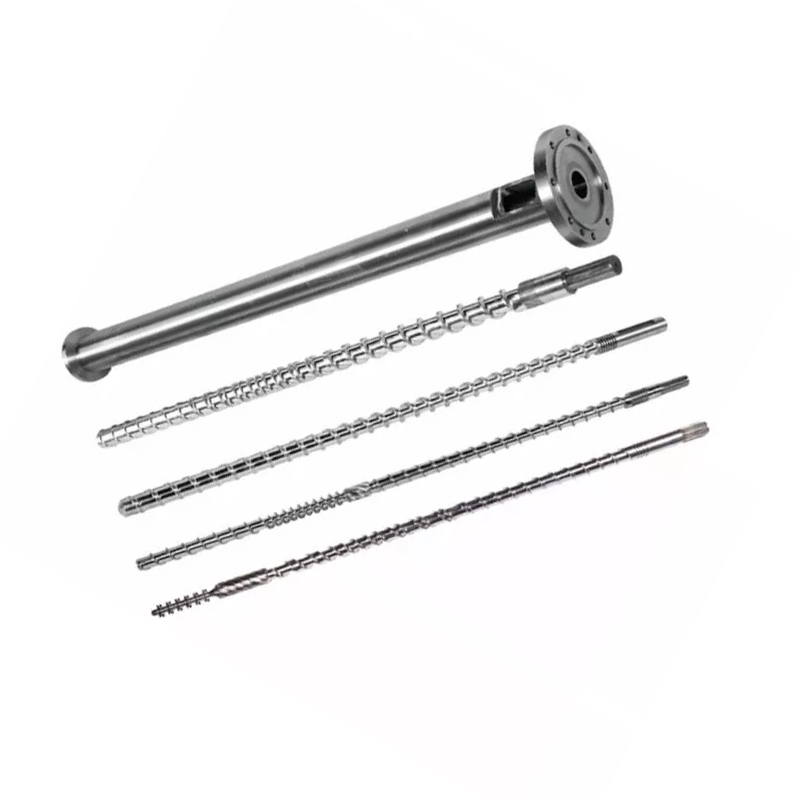
L/D is the working length of the screw (L) divided by its outside diameter (D). A screw 22 times longer than it is wide has an L/D of 22:1.
The ratio scales with size. A 40 mm screw at 22:1 has a working length of 880 mm. An 80 mm screw at 22:1 is 1,760 mm long. Same ratio, very different machines.
What the ratio actually describes is how much runway the screw has to do its work. Feeding, melting, and metering all happen along that length. More length means more melting capacity and more mixing. Less length means less of both, and less time for material to sit hot.
Most injection screws land between 18:1 and 25:1, with 20:1 to 22:1 the common ground on general-purpose machines. The pillar guide covers the full picture in our injection molding screw barrel guide.
Why Injection L/D Is Shorter Than Extrusion L/D
Extruders commonly run 25:1 to 33:1. Injection screws stay shorter, and the reason is the cycle, not tradition.
An extruder screw rotates continuously. Material enters at one end, moves through, and leaves at the other. Nothing waits.
An injection screw works in bursts. It rotates to plasticize one shot, retracts, then stops. It injects, and the mold cools. During all of that, the melt already in the barrel sits still and stays hot.
That waiting is the whole difference. A longer barrel holds more melt, and on an injection machine, more melt means more material waiting through more cycles. For a heat-sensitive resin, extra length is not extra capacity. It is extra thermal history.
So injection design balances melting capacity against residence time, while extrusion mostly just buys melting capacity.
The Thing Nobody Tells You: You Cannot Change L/D
Articles about L/D talk as if you get to pick a number. On a machine you already own, you do not.
L is fixed by the barrel. The barrel is a machined pressure vessel bolted into the machine frame, with its heater zones, feed throat, and mounting all built around one length. Nobody makes a barrel longer.
So the only variable left in L/D is D, the screw diameter. Change the diameter, and the ratio changes with it, because the length above the line never moves.
This is why machine builders list two or three screw diameters for the same machine. They are not offering you three shot sizes. They are offering you three points on a trade-off curve, and shot size is only one of the things moving.
Screw Diameter: The Lever That Moves Everything
In a fixed barrel, one choice moves four things at once. Understand this table and you understand injection L/D.
| If you choose a... | Smaller screw diameter | Larger screw diameter |
|---|---|---|
| L/D ratio | Higher (same L, smaller D) | Lower (same L, bigger D) |
| Shot capacity | Smaller (less volume per mm of stroke) | Larger |
| Injection pressure available | Higher (same force on a smaller area) | Lower |
| Melting capacity per shot | Better (more L/D for less material) | Less generous |
| Residence time for a given part | Shorter (shot uses more of a smaller barrel) | Longer |
| Suits | Small precision parts, thin walls, high-viscosity and heat-sensitive resins | Large shots, commodity resins, thick sections |
Read the pressure row again, because it decides more jobs than people expect. The machine's hydraulic or electric drive delivers a fixed force to the back of the screw. Pressure is force divided by area. A smaller screw has less face area, so the same force produces higher melt pressure.
That is why thin-wall and high-viscosity work often lands on the small screw: it can push melt into a tight cavity that a big screw cannot fill. The higher L/D that comes with it is a bonus, not a coincidence.
And read the residence row too. It is the one that quietly decides whether your PC yellows.
How L/D Affects Shot Size
Strictly, L/D does not set shot size. Diameter and stroke do: shot volume is the screw's cross-sectional area multiplied by how far it travels.
But on a real machine you cannot separate them, because the same diameter that sets your shot also sets your L/D. Pick the small screw for a small precision part, and you have chosen a higher L/D at the same moment.
The practical consequence is a happy one. The screw that gives you the small shot also gives you more melting length per gram of material and higher injection pressure. Those three properties suit the same jobs, which is why the trade works out cleanly more often than not.
Where it stops being happy is when you force a part onto the wrong screw. Run a very small shot on a large-diameter screw and you get the worst of both: a low L/D, a huge barrel volume relative to your shot, and material that cycles through heat for far too long.
Residence Time: The Quality Killer You Can Calculate
Residence time is how long a given piece of polymer stays hot inside the barrel before it is injected. It is the most underrated number in injection molding, and you can estimate it in thirty seconds.
Residence time ≈ (barrel shot capacity ÷ your shot size) × cycle time
Both capacities in the same units. Take shot capacity from the machine's rating.
Work an example. A machine rated at 200 g of shot capacity, running a 20 g part on a 30-second cycle. The ratio is 10, so the melt sits through roughly ten cycles. Residence time is about 300 seconds, or five minutes.
Five minutes at melt temperature is a long time for PC, POM, PET, or PVC. Nothing about your settings is wrong. The part is simply too small for the barrel, and the material is cooking while it waits its turn.
Now move that job to a smaller screw. Shot capacity drops to, say, 80 g. The same 20 g part now uses a quarter of the barrel, the melt sits through four cycles instead of ten, and residence time falls to roughly two minutes.
You changed no setpoint. You changed the screw diameter, and the degradation problem went with it.
The 20–80% Shot Capacity Band
Commonly cited industry guidance is to keep your shot somewhere between roughly 20% and 80% of the machine's rated shot capacity. Confirm the band against your machine's manual, but the logic behind it holds everywhere.
Below the band, residence time runs long. Material makes too many trips through the heat, and heat-sensitive resins degrade. This is the failure the formula above catches.
Above the band, two things break. There is not enough barrel left to hold a proper cushion, so packing gets inconsistent shot to shot. And the screw has less time and length to melt a nearly full barrel of material, so melting quality suffers exactly when you are asking the most of it.
Land in the middle of the band and the machine has room to work. If your part sits outside it, the correct fix is a different screw diameter, or a different machine, not a heroic set of process settings.
How L/D Affects Melt Quality
Length is melting capacity, and melting capacity is quality.
More L/D gives more complete melting. Solid pellets have further to travel against the hot barrel wall, so fewer of them survive as unmelts. Hard specks and lens-shaped inclusions in the part are melting failures, and length fights them.
More L/D gives more homogeneous melt. Temperature evens out, color and filler distribute better, and the melt arriving at the check ring is more consistent from shot to shot. That shows up as a wider process window.
More L/D also gives more thermal history. The same length that melts thoroughly also holds material longer, and for PVC, PC, POM, and PET, that is a cost, not a benefit.
So melt quality is not a case of more is better. It is a balance: enough length to melt completely, not so much barrel volume that the material waits too long to be used. When melting capacity is your specific constraint, a barrier screw raises it without adding a millimetre of barrel.
Choosing L/D and Diameter by Resin and Part
Put the trades together and the choice falls out of the resin and the part.
| Your situation | Lean toward | Why |
|---|---|---|
| Small, thin-walled precision parts | Smaller screw, higher L/D | Higher injection pressure fills thin sections; good melting per gram; short residence |
| Heat-sensitive resin (PC, POM, PET, PVC) | Smaller screw for the shot; shorter end of the L/D band | Residence time is the enemy. Keep the shot large relative to barrel capacity |
| High-viscosity engineering resin | Smaller screw, higher L/D | Needs pressure to fill and length to melt thoroughly |
| Large shots, commodity resin (PE, PP, PS) | Larger screw, lower L/D | Capacity leads; these resins tolerate the reduced melting length |
| Thick-walled parts, slow cycles | Larger screw, watch residence | Long cycles multiply residence time. Recalculate before committing |
| Glass-filled or abrasive compound | Diameter per the part; change the surface | L/D follows the part. The wear answer is a bimetallic bore, not a different length |
| Unmelts at high output | Same diameter; barrier screw | You need melting capacity, not barrel length. The barrel is not changing anyway |
Note the last two rows. Two of the most common problems molders bring to us are not L/D problems at all, and buying a different screw diameter to solve them wastes the money.
Common L/D Mistakes in Injection Molding
- Copying an extrusion L/D. A 30:1 number from an extruder table applied to an injection screw ignores the residence-time problem that defines injection molding. The two machines do different jobs.
- Assuming longer is better. More length is more melting and more thermal history. On heat-sensitive resin, the second one wins and the material degrades.
- Ignoring the shot-to-capacity ratio. The most common quality problem we see traced to geometry is a small part cooking in a big barrel. Nobody checks it, because it is not on any settings screen.
- Believing L/D can be changed on an existing machine. It cannot. The barrel sets L. Only the diameter is yours to choose.
- Blaming L/D for a melting problem. If unmelts appear only at high output, your melting capacity is short, not your barrel. A barrier screw fixes that in the same barrel.
- Blaming L/D for a wear problem. Falling output at the same screw speed is worn clearance, not geometry. Measure it before you redesign anything.
How to Order the Right Screw
A screw manufacturer designs from what you tell them. Send these, and the diameter and geometry recommendation follows.
- Machine brand, model, and current screw diameter. A nameplate photo covers most of it, and it tells us the barrel length you are working inside.
- Rated shot capacity of the machine, if you know it, and your actual part weight.
- Cycle time. With the two numbers above, residence time can be calculated for you.
- Resin, grade, and filler content. This drives the compression profile and the surface treatment as much as the diameter.
- The defect you want gone. Yellowing points at residence. Unmelts point at melting capacity. Short shots point at pressure or at the check ring. Each has a different answer.
- A drawing, or your worn screw. Either lets us build to your machine. A worn part is measured on CMM equipment to ±0.01 mm and the geometry reconstructed.
Why Work With Nanhaiya
Send us the part weight, the cycle time, and the machine model, and we will run the residence-time arithmetic before we quote you anything. Sometimes the answer is a different screw diameter. Sometimes it is a barrier screw in the barrel you already have. Occasionally it is that your job belongs on a different machine, and we will say so.
When a new screw is the answer, Nanhaiya has built injection molding screws and barrels for more than twenty years, in 38CrMoAlA, 42CrMo, SKD-61, and stainless steel, nitrided or bimetallic with a 2.5–3 mm tungsten-bearing alloy layer at up to 62 HRC where the feed demands it.
We build to your drawing, machine model, or worn sample, with replacements compatible with major machine brands, a minimum order of one set, and a quote within 12 hours.
Fighting yellowing, unmelts, or short shots? Send your machine model, part weight, cycle time, and resin. We will tell you whether it is L/D, diameter, melting capacity, or wear, and quote within 12 hours.
Get a Screw RecommendationFrequently Asked Questions
What is a typical L/D ratio for an injection molding screw?
Most injection screws run between 18:1 and 25:1, with 20:1 to 22:1 the common ground on general-purpose machines. Heat-sensitive resins favor the shorter end because material spends less time hot. Engineering plastics that need thorough melting favor the longer end.
Can I change the L/D ratio on my injection molding machine?
Not directly. The length is fixed by the barrel, which is machined into the machine. What you can change is the screw diameter, and because L stays the same, a smaller diameter automatically gives a higher L/D. That single choice also changes your shot capacity and available injection pressure.
Does L/D ratio affect shot size?
Indirectly, and inseparably. Shot volume comes from screw diameter and stroke, not from L/D. But on a fixed barrel, the diameter that sets your shot also sets your L/D. Choose a smaller screw for a smaller shot, and you get a higher L/D and higher injection pressure at the same time.
How do I calculate residence time in injection molding?
Divide the machine's rated shot capacity by your actual shot size, then multiply by cycle time. A 200 g machine running a 20 g part on a 30-second cycle gives roughly 300 seconds, or five minutes, of residence. That is a long time to hold PC, POM, PET, or PVC at melt temperature.
Why is injection L/D shorter than extrusion L/D?
Because an injection screw works in bursts. It plasticizes a shot, then stops while the machine injects and the mold cools, and the melt in the barrel sits hot the whole time. An extruder runs continuously and nothing waits. Extra barrel length on an injection machine is extra thermal history, not just extra melting capacity, so injection screws stay shorter.
What percentage of barrel capacity should my shot use?
Commonly cited guidance is roughly 20% to 80% of rated shot capacity, and your machine manual is the authority. Below that band, residence time runs long and heat-sensitive material degrades. Above it, there is no room for a proper cushion and less time to melt a nearly full barrel.
Is a higher L/D better for injection molding?
Not automatically. More length gives more complete melting and a more uniform melt, which improves quality. It also holds more material hot for longer, which degrades heat-sensitive resins. The right L/D melts your material completely without holding it any longer than it needs.
My parts are yellowing. Is that an L/D problem?
Usually it is a residence-time problem, which is a shot-size-to-barrel-capacity problem. Run the residence calculation first. If a small part is cooking in a large barrel, no temperature setting and no screw geometry will fix it. A smaller screw diameter, or a smaller machine, will.