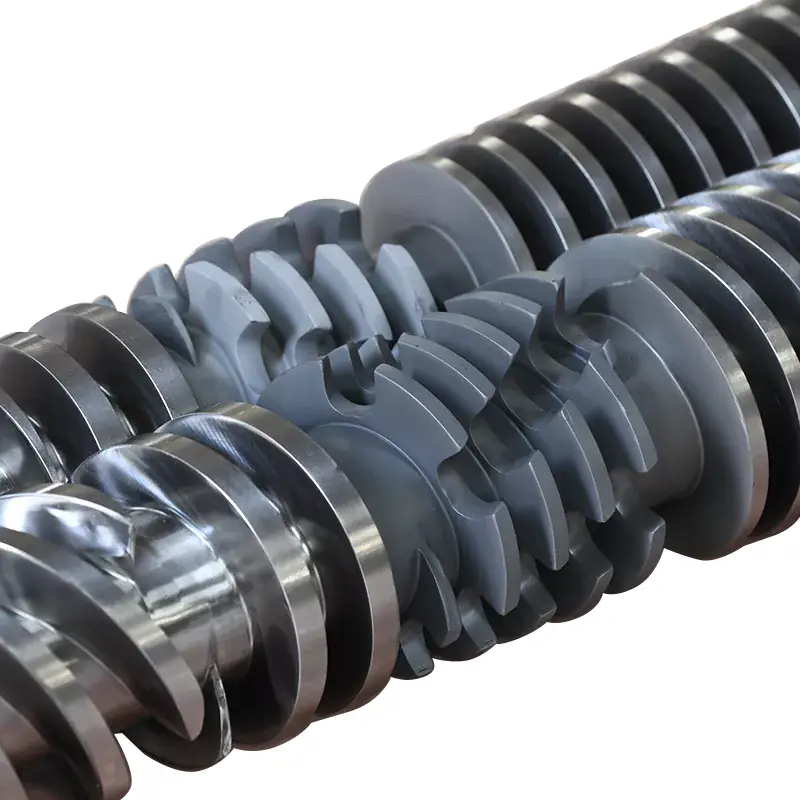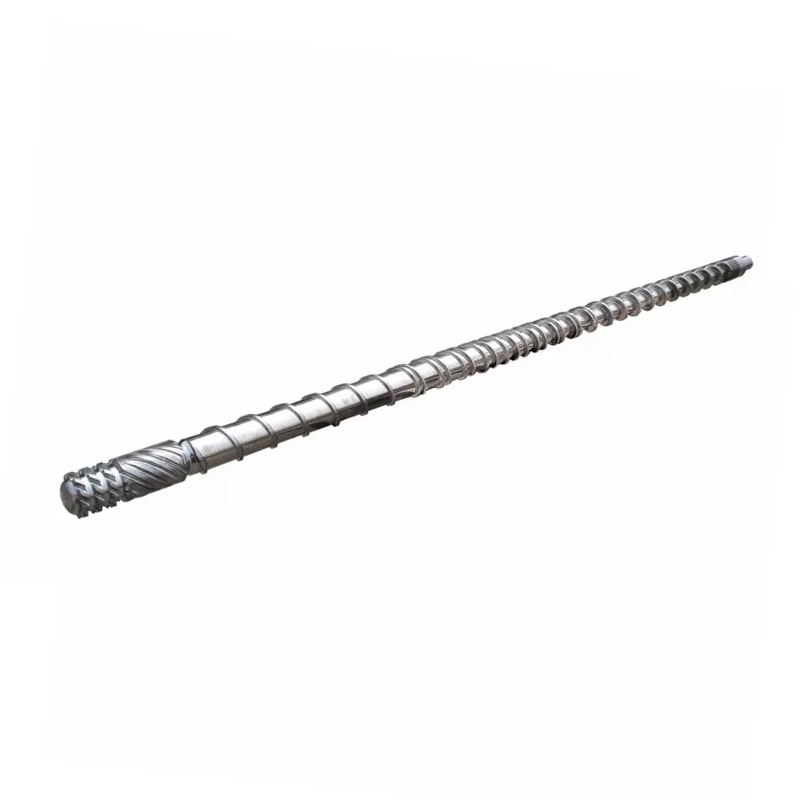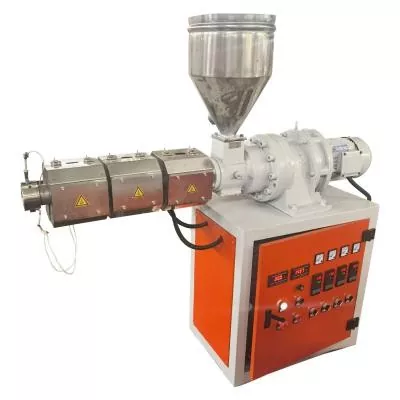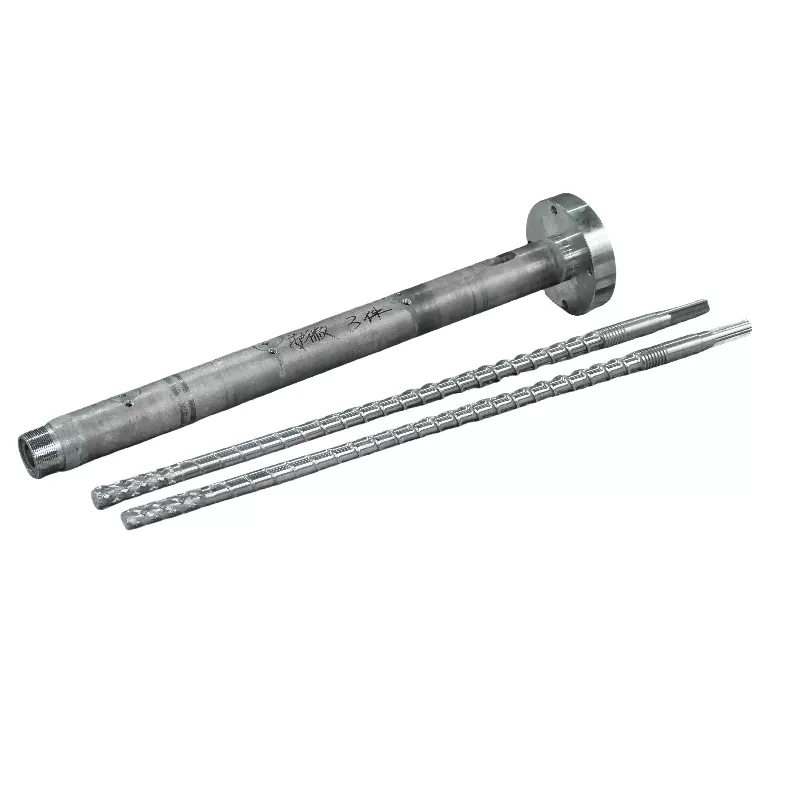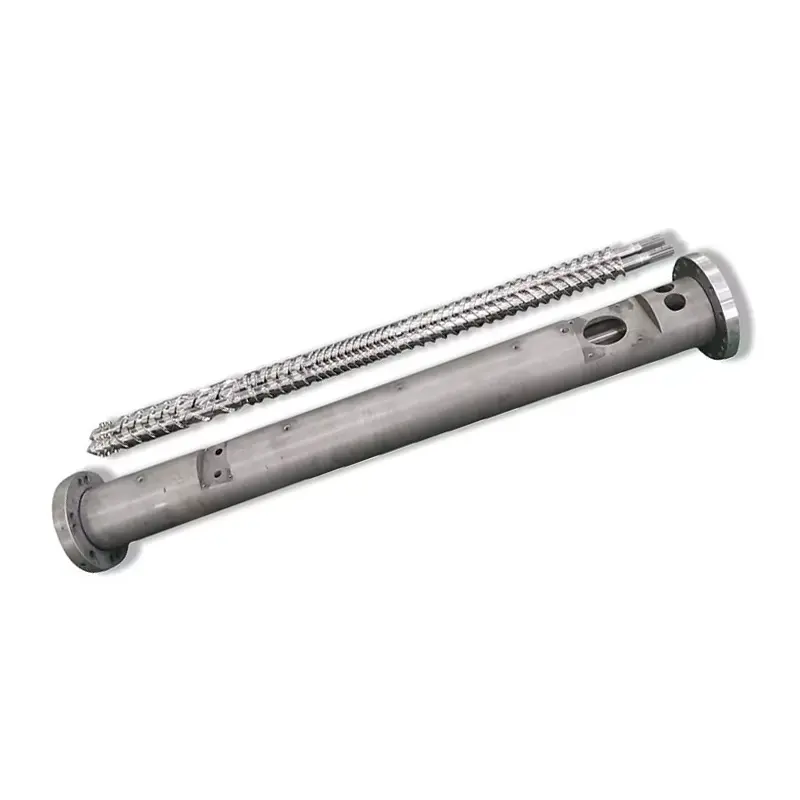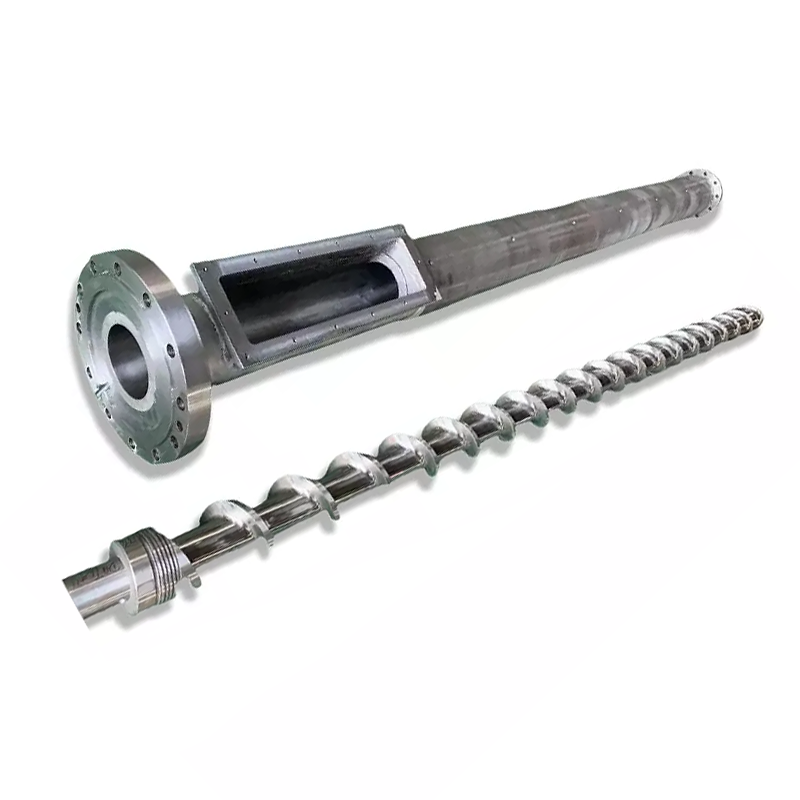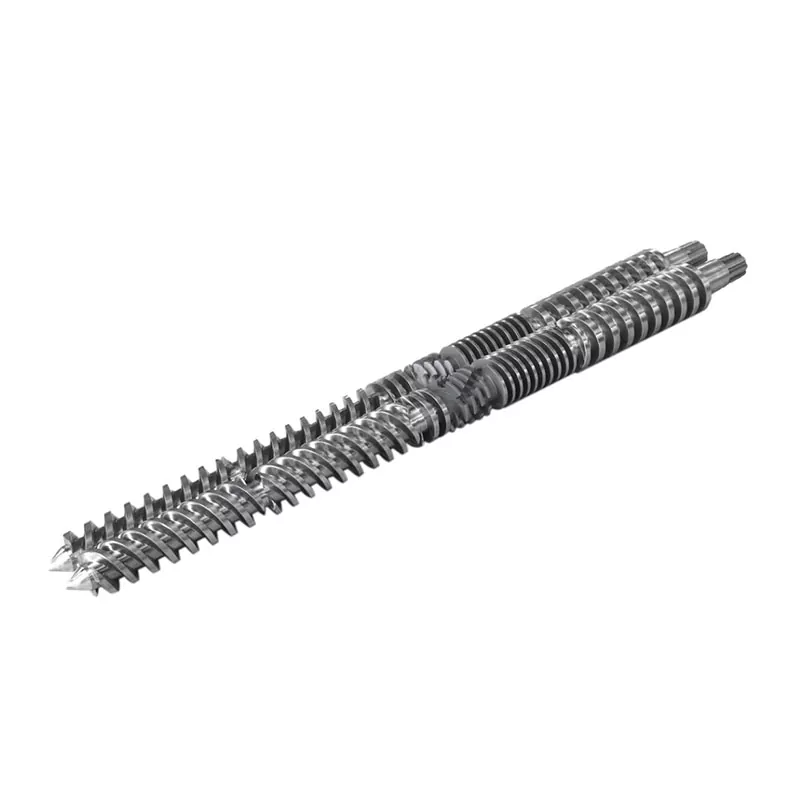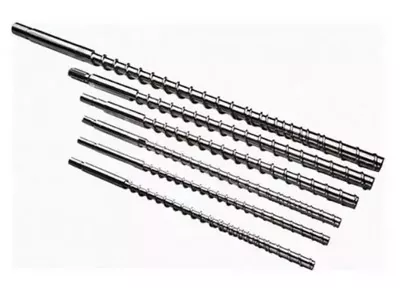

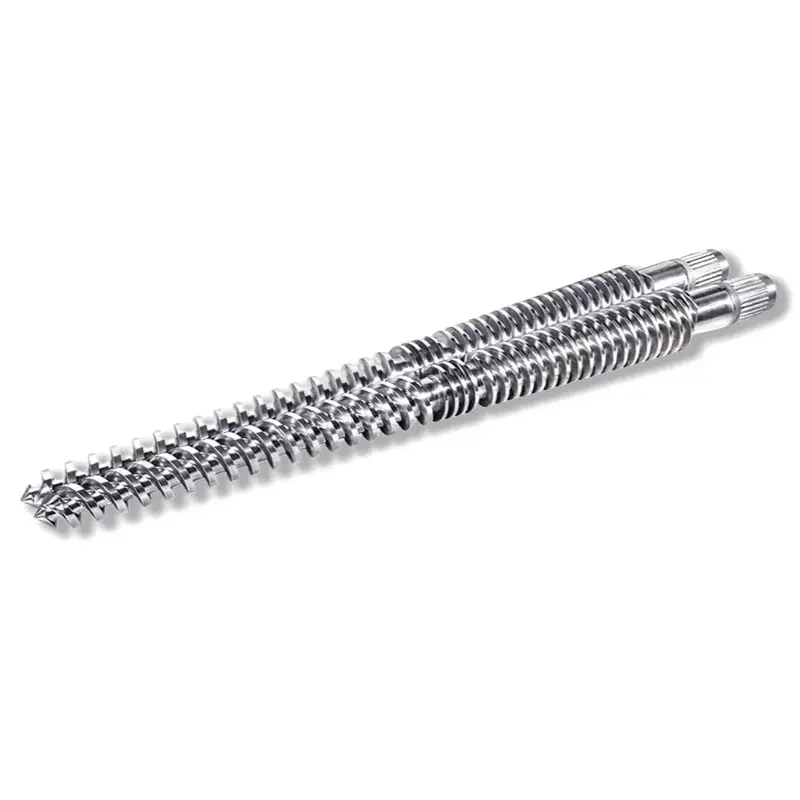
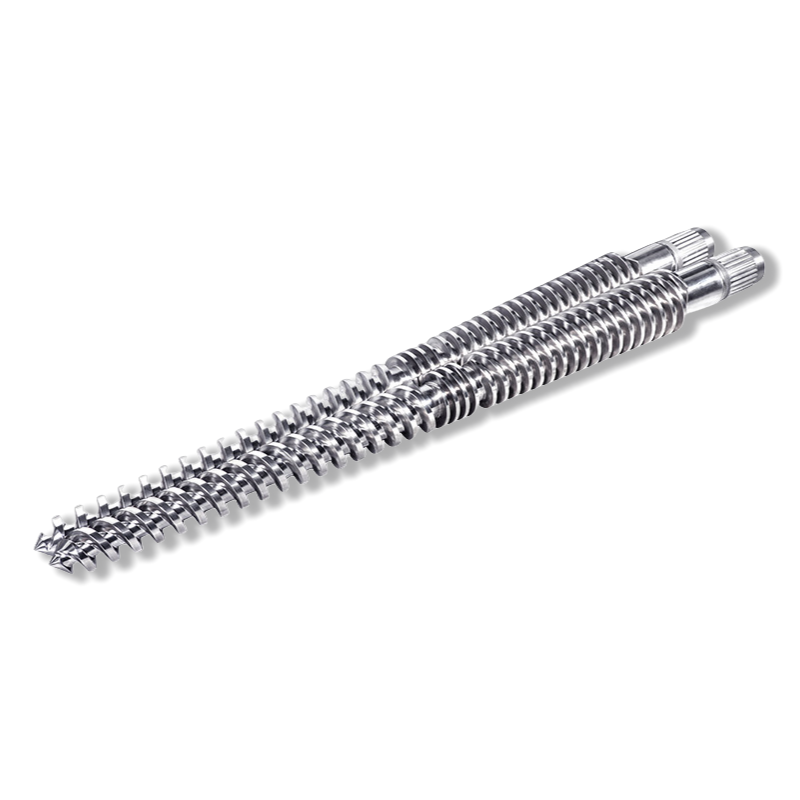
A conical twin screw barrel holds two tapered screws side by side in a barrel whose bores narrow from the feed end toward the die. That taper is the whole design. It gives a large intake for low-density powder, a compression that builds gradually instead of abruptly, and rising pressure toward a short discharge. The result is gradual compression, gentle shearing, and strong conveying, which is exactly what shear-sensitive and heat-sensitive material like rigid PVC needs.
Walk into any PVC pipe or profile plant and the machine on the line is almost certainly a conical twin screw. That is not an accident of history. The shape of the screws solves a specific set of problems that PVC creates, and once you see why, the whole machine makes sense.
This guide covers the mechanics, the size notation that confuses most buyers, the real applications, and the sizes we build.
What Is a Conical Twin Screw Barrel?
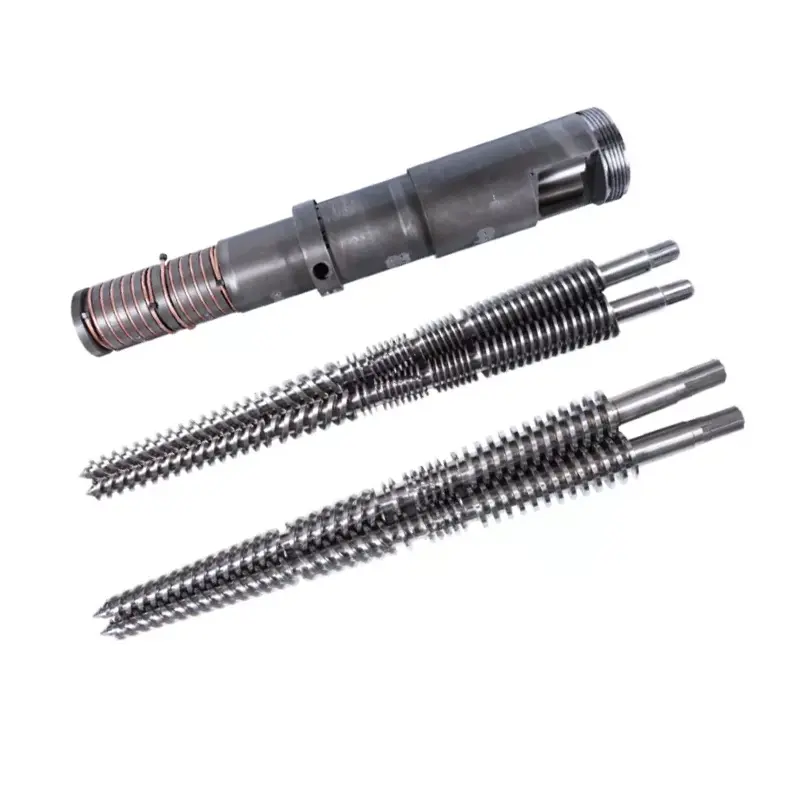
A conical twin screw barrel is the plasticizing unit of a conical twin screw extruder. It has two parts working as one: a barrel with two overlapping tapered bores, and two tapered screws that sit inside them.
Conical means the screws are wide at the feed end and narrow toward the discharge end. The bores taper to match. Everything about the machine follows from that single geometric fact.
Compare that with a parallel twin screw barrel, where both screws hold the same diameter from end to end inside a constant figure-eight bore. Same idea of two screws working together, completely different consequences.
How to Read a Conical Screw Size Like 55/110
Every conical quote, drawing, and RFQ carries a paired number: 45/90, 55/110, 65/132, 80/156. Buyers see these constantly and often are not sure which number is which. It is worth thirty seconds to settle.
The two numbers are the two ends of the screw. The smaller number is the diameter at the discharge end, where the screw meets the die. The larger number is the diameter at the feed end, under the hopper. A 55/110 screw measures 55 mm at the tip and 110 mm at the intake.
Read it that way and the size tells you a great deal at a glance. The gap between the two numbers is the taper, and the taper is where the compression happens. The large end sets how much material the machine can swallow; the small end sets the pressure it can develop at the die.
This is also why a conical set cannot be substituted casually. Two screws with the same discharge diameter but different feed diameters are different machines with different compression behaviour, even though the first number matches.
How a Conical Twin Screw Barrel Works, Step by Step
- Feeding. Material drops into the wide end. PVC usually arrives as a dry blend powder, which is bulky and low in density, and the large intake gives it the volume it needs. On many lines the powder is force-fed rather than left to fall under gravity.
- Conveying. The two screws intermesh, and the flight of one wipes the channel of the other. Material is trapped in closed chambers and pushed forward mechanically rather than dragged along by friction.
- Compression. As the bore narrows, the same material occupies less and less volume. Air is squeezed out, particles are pressed together, and density rises steadily along the length.
- Plasticizing. Barrel heat and mechanical work together fuse the compacted powder into a homogeneous melt. Zones are heated and cooled independently so each section holds the temperature that stage needs.
- Degassing. Moisture and volatiles are drawn off through a vent before they can spoil the surface of the product.
- Metering and discharge. The narrow end builds pressure and delivers a steady, uniform melt into the die.
Temperature control matters more here than in most extrusion. Our barrels use a multi-stage heating and cooling system with the zones divided by function, feeding, compression, and homogenization, so each section can be set to what that stage of plasticization actually requires instead of following one global setpoint.
Why the Taper Matters: Three Effects
The taper is not a styling choice. It produces three mechanical effects at once, and together they define what this machine is good at.
1. A large intake for low-density powder
Rigid PVC is processed as a dry blend: resin powder plus stabiliser, lubricant, filler, and pigment. That blend is fluffy and full of air, so it needs volume before it needs anything else.
The wide feed end gives it that volume. A screw of constant diameter would have to be large along its whole length to swallow the same intake, which brings problems of its own at the discharge end.
2. Compression that builds gradually
On a constant-diameter screw, compression comes from making the channel shallower, and that change tends to happen over a defined transition section.
On a conical screw, the bore itself narrows continuously. Compression is spread along the length instead of concentrated in one zone, so material is worked steadily rather than squeezed hard in one place. That is what “gradual compression ratio” means in practice, and heat-sensitive material benefits from it directly.
3. Rising pressure toward a shorter discharge
The narrowing end concentrates the melt into a smaller cross section, which builds the pressure the die needs. At the same time, the discharge section is short, so the melt does not sit hot at high pressure any longer than necessary.
For a polymer that degrades with time at temperature, a short high-pressure section is a feature rather than a limitation.
Gentle Shearing: Why PVC Ended Up on This Machine
Rigid PVC has a narrow processing window. Work it too hard and it degrades, releasing hydrogen chloride, which then attacks the steel it is sitting against. Work it too little and it never fuses properly. The machine has to thread that gap on every run.
Conical twin screws thread it by design. Their combination of gradual compression ratio, gentle shearing, and strong conveying capacity suits materials that are sensitive to both shear and temperature, and PVC is the textbook case of both.
Strong conveying is the third leg and it matters as much as the gentle part. Because the screws intermesh and push material mechanically, the machine does not depend on friction to move a powder that grips poorly. Output stays steady even though the feed is a dry blend rather than pellets.
The chemistry side of this, and what it means for surface treatment, is covered in our PVC screw barrel guide.
Intermeshing vs Non-Intermeshing Conical Screws
Conical is not one thing. How deeply the two screws engage changes the machine's behaviour, and we build both configurations.
Intermeshing conical twin screws engage each other, so the flight of one screw reaches into the channel of the other. The closed chambers this creates give positive conveying and thorough, controlled mixing, and the screws wipe each other clean as they turn. This is the configuration behind most PVC pipe, profile, and sheet work.
Non-intermeshing conical twin screws sit side by side without engaging. Conveying is less positive and shear is lower, which suits material that cannot tolerate much working at all.
The practical point for buyers is the same one that applies to the size notation: a replacement has to match the configuration of the machine you own. Nanhaiya was among China's earliest manufacturers to specialise in both intermeshing and non-intermeshing conical twin screws, so a set can be built either way.
Conical or Parallel? The Short Version
Both are twin screws. They are built for different problems.
| Conical twin screw | Parallel twin screw | |
|---|---|---|
| Screw shape | Tapered, wide feed to narrow discharge | Constant diameter end to end |
| Compression | Gradual, spread along the taper | Set by channel depth in a transition zone |
| Shear | Gentle | Adjustable, can be high |
| Feed handling | Large intake, ideal for bulky dry blend powder | Positive conveying, wide feed tolerance |
| Typical duty | Rigid PVC pipe, profile, sheet and board | Compounding, masterbatch, pelletizing, high output lines |
The rule of thumb: if the material is heat-sensitive and arrives as powder, the taper is working for you. If the job is compounding or high-volume pelletizing, a parallel machine usually wins. The full comparison sits in our conical vs parallel guide.
What Conical Twin Screws Actually Produce
Four families cover the output: profiles, sheets, pipes, and custom-shaped profiles. In practice that means a long list of everyday products.
PVC products
PVC foam boards and decorative boards such as ceiling and wall panels. PVC-U water supply and drainage pipe, conduit pipe, and small-diameter corrugated pipe. Door and window profiles, both frames and sashes. Ceiling panels and cable trays. Flexible hoses such as garden hose and conduit, and sealing strips for doors and windows.
Modified and composite products
PVC wood-plastic composite flooring, railings, and decorative mouldings. Calcium-carbonate-filled PVC sheet, including engineering mats. Talc-filled PP profiles for less demanding applications.
Wood-plastic work deserves its own note. Nanhaiya appeared at the 18th China Wood Plastics Summit Forum as one of China's largest suppliers of conical twin-screw barrels for WPC, and the wear side of that duty is covered in our WPC screw barrel guide.
Other specialty products
ABS decorative strips for home appliances and automotive interiors. PE/PVC composite water supply pipe, which combines the toughness of PE with the rigidity of PVC.
Within PVC sheet specifically, building materials account for around 60% of the end use, with packaging second. Those lines typically run counter-rotating conical screws with the raw material force-fed, so plasticizing, mixing, and shearing stay stable through the whole process.
The Sizes We Build
These are the conical twin screw and barrel specifications we produce, written as discharge diameter over feed diameter.
| Φ45/Φ90 | Φ45/Φ100 | Φ51/Φ105 | Φ55/Φ110 |
| Φ58/Φ124 | Φ60/Φ125 | Φ65/Φ120 | Φ65/Φ132 |
| Φ68/Φ143 | Φ75/Φ150 | Φ80/Φ143 | Φ80/Φ156 |
| Φ80/Φ172 | Φ92/Φ188 | Φ105/Φ216 | Φ110/Φ220 |
That range covers roughly 90% of the conical twin screws in service on the market, and the individual product lines behind it, including PVC board and PVC profile sets, sit under our conical twin screw barrels. If your machine falls outside the list, the geometry can be designed to match your line rather than forced onto the nearest standard size.
Notice the pairs that share a first number. 65/120 and 65/132 both discharge at 65 mm but take in very different volumes, and 80/143, 80/156, and 80/172 make the same point three times over. The feed diameter is not a detail.
When a Conical Set Needs Replacing
Conical screws wear where the pressure is highest, which is toward the narrow discharge end. The machine signals it before the parts look obviously bad.
- Output falls at the same screw speed, because worn clearance lets melt slip backward instead of moving forward.
- Plasticizing quality drops. On PVC that shows as poor fusion, uneven colour, or surface defects on the profile.
- Motor load climbs at constant output, pointing at drag, misalignment, or degraded material building resistance.
- Black specks return after cleaning, which on PVC often means degraded material is lodging in worn clearance and cooking there.
Confirm with instruments rather than impressions. Measure the screws and the bore against the build drawing, and check the clearance between the two screws as well as between screws and barrel.
Why Work With Nanhaiya
Nanhaiya has manufactured screws and barrels for over twenty years and serves 500+ clients worldwide. Our conical twin screw barrel range covers PVC board, PVC sheet, PVC profile, and PE duty, in intermeshing and non-intermeshing configurations, matching around 90% of the conical machines in service.
Choosing correctly takes three steps, and we work through them with you: identify the material being processed, understand what the line has to produce, then match the barrel to the equipment you actually own. For non-standard machines, our engineers design the geometry to fit.
Surface treatment is specified separately from geometry, because it depends on how abrasive and corrosive your formulation is. We supply nitriding, chrome plating, stainless steel, bimetallic surfacing, and tungsten carbide spraying, and where the feed demands it we spray hard alloy the full circle around the bore's wear zone to bring the inside hardness to 62 HRC. Our bimetallic vs nitrided guide explains when that pays, and the materials guide covers the base steels.
Send your machine model, the screw size as both numbers, and the material you run. You get a quote within 12 hours.
Need a conical twin screw set built to your machine? Send the size, your extruder model, and your formulation. We quote within 12 hours.
Get a Conical Twin Screw QuoteFrequently Asked Questions
What is a conical twin screw barrel?
It is the plasticizing unit of a conical twin screw extruder: a barrel with two overlapping tapered bores holding two tapered screws. The screws are wide at the feed end and narrow toward the die, and that taper produces gradual compression, gentle shearing, and strong conveying.
How does a conical twin screw barrel work?
Material enters the wide feed end, where the large intake suits bulky powder. The intermeshing screws convey it forward mechanically, and as the bore narrows the material is compressed steadily, with air squeezed out and density rising. Heated zones fuse it into a uniform melt, volatiles are vented off, and the narrow discharge end builds the pressure the die needs.
What do the two numbers in a conical screw size mean?
The smaller number is the diameter at the discharge end, and the larger number is the diameter at the feed end. A 55/110 screw measures 55 mm at the tip and 110 mm at the intake. Always give both numbers when requesting a quote, because sizes such as 65/120 and 65/132 share a first number but are not interchangeable.
Why are conical twin screws used for PVC?
Rigid PVC is sensitive to both shear and temperature, and it arrives as a bulky dry blend powder. The conical design answers all three problems at once: a large feed end swallows the powder, gradual compression works the material steadily instead of squeezing it hard in one zone, and gentle shearing keeps it from degrading.
What is the difference between conical and parallel twin screws?
A conical twin screw tapers from a wide feed end to a narrow discharge end, giving gradual compression and gentle shear, which suits rigid PVC pipe, profile, and sheet. A parallel twin screw holds a constant diameter throughout, which suits compounding, masterbatch, and high-output pelletizing where adjustable shear matters more.
What is the difference between intermeshing and non-intermeshing conical screws?
Intermeshing screws engage each other, so the flight of one reaches into the channel of the other. That creates closed chambers, positive conveying, and thorough mixing, and the screws wipe each other clean. Non-intermeshing screws sit side by side without engaging, giving lower shear and less positive conveying for material that cannot tolerate much working.
What products are made with conical twin screw extruders?
Four families: profiles, sheets, pipes, and custom-shaped profiles. In practice that covers PVC foam and decorative board, PVC-U water and drainage pipe, conduit, door and window profiles, ceiling panels, cable trays, hoses and sealing strips, wood-plastic composite flooring and railings, filled PVC sheet, ABS decorative strips, and PE/PVC composite pipe.
Do conical twin screws have to be replaced as a pair?
Yes. The clearance between the two screws is set during manufacture and cannot be recovered by fitting one new screw against a worn partner. Conical twin screws are produced, supplied, and replaced as a matched pair, and they should be stored and handled that way too.