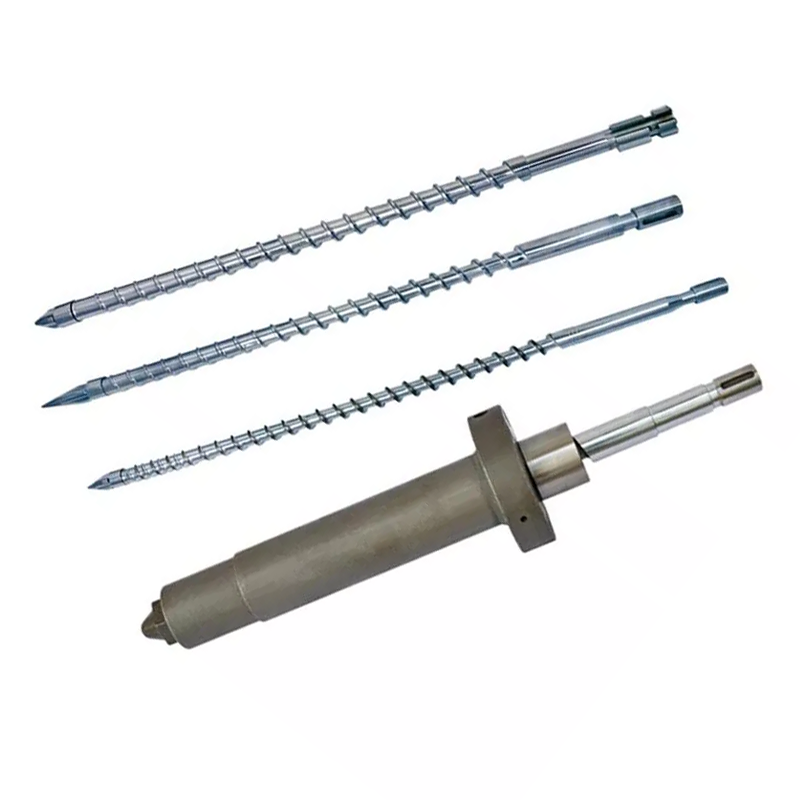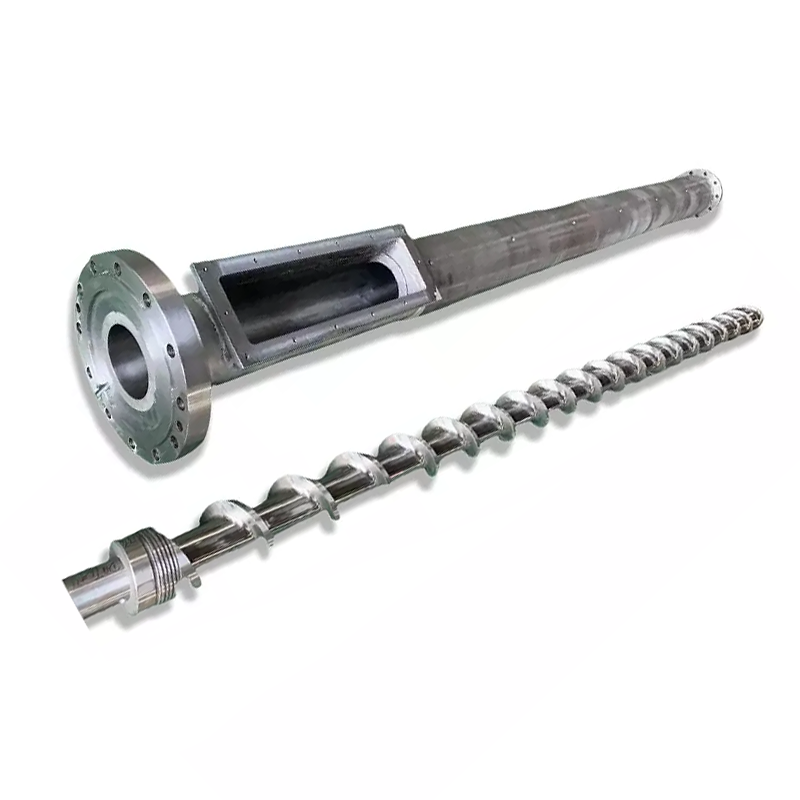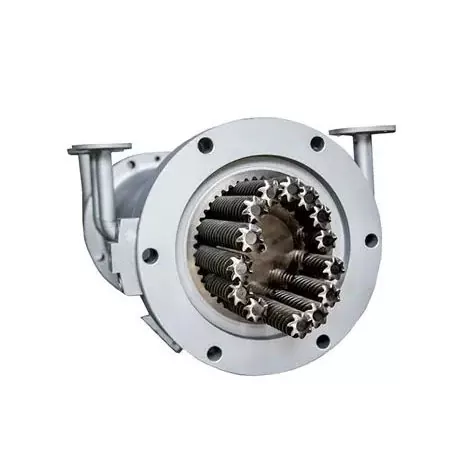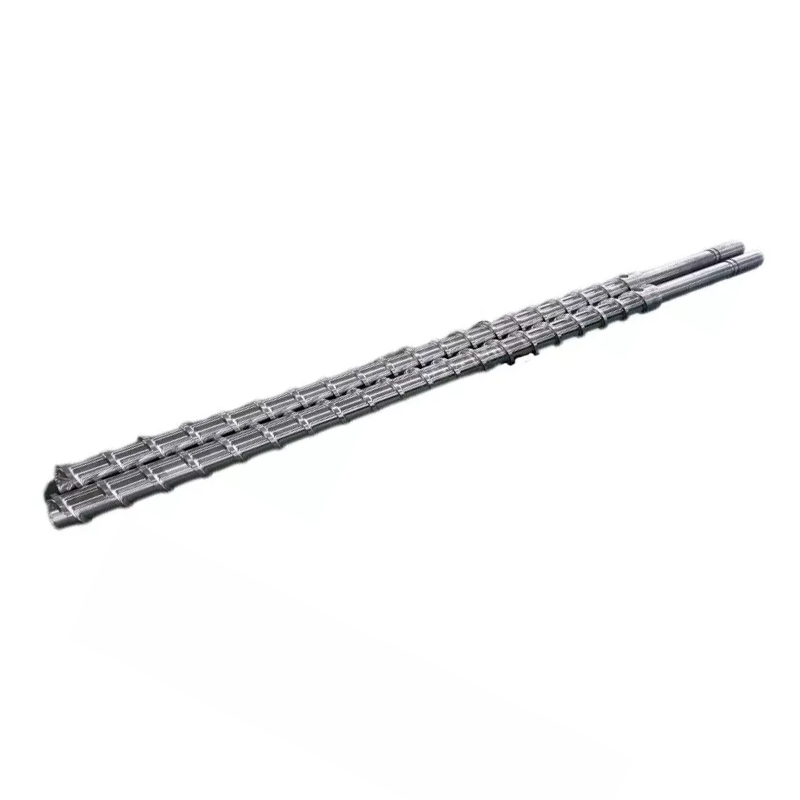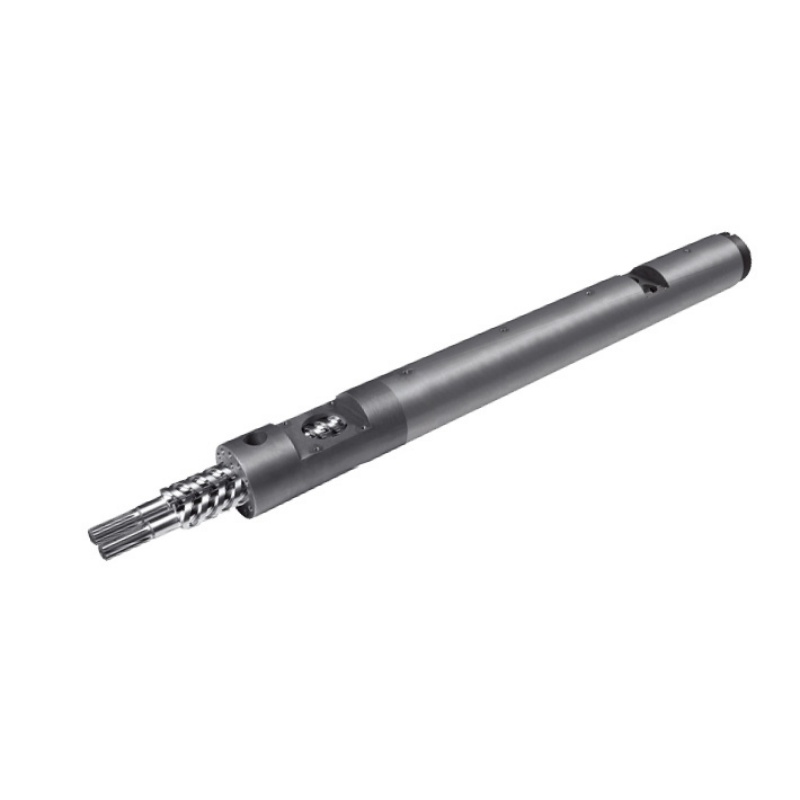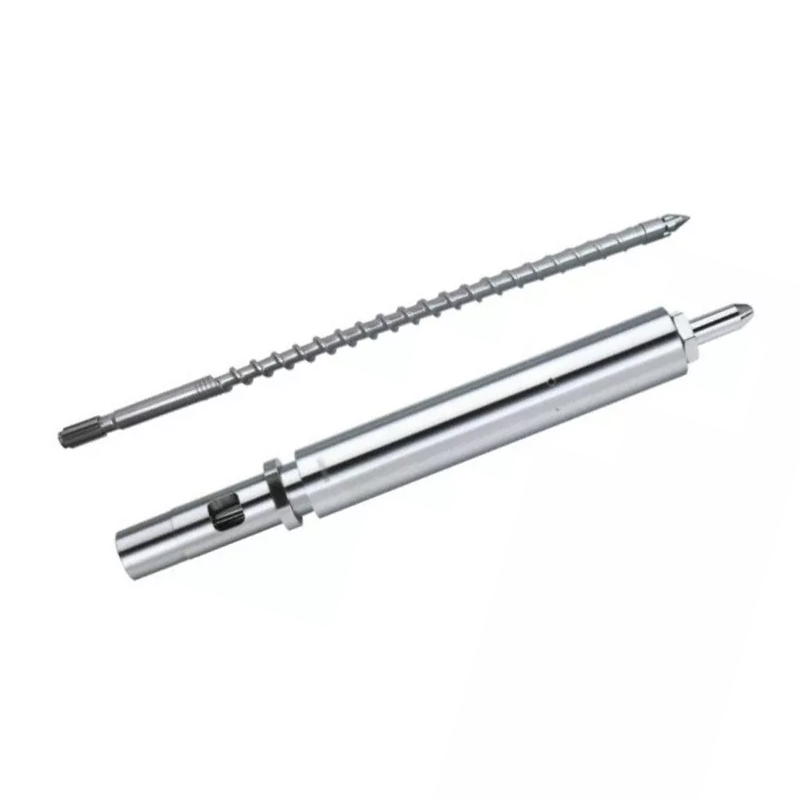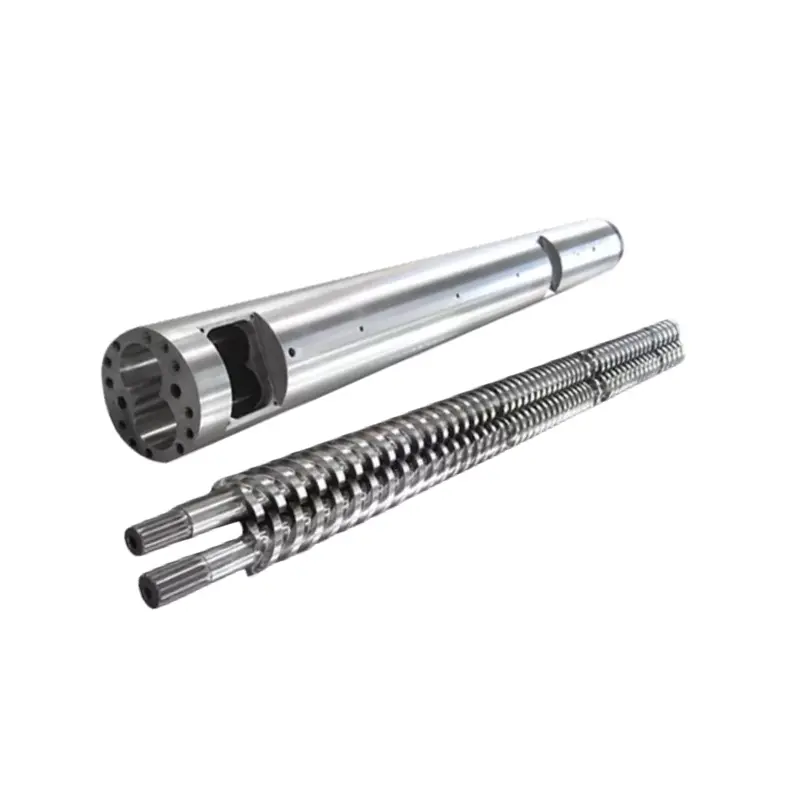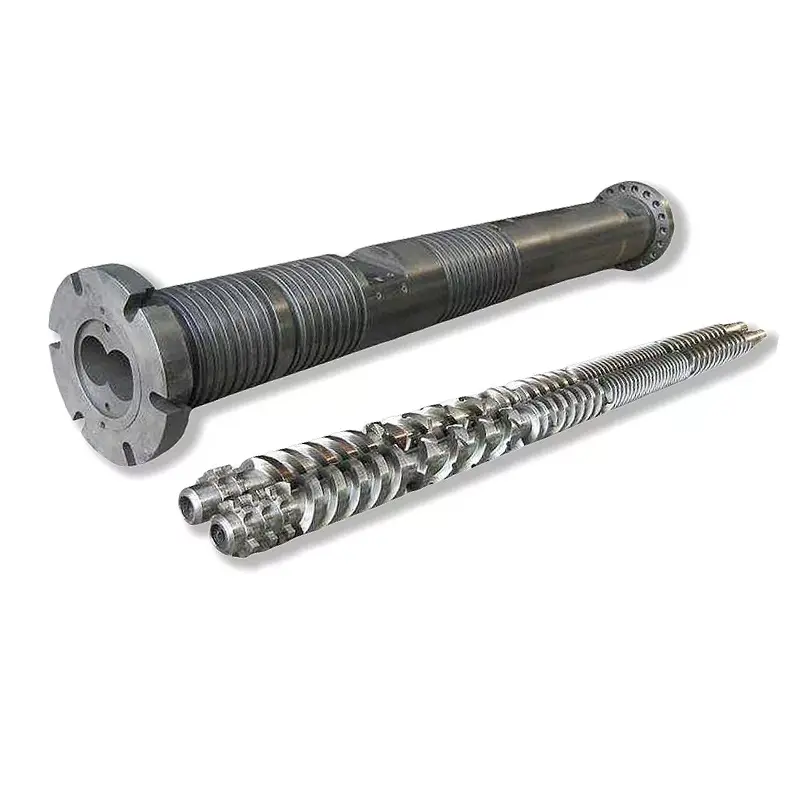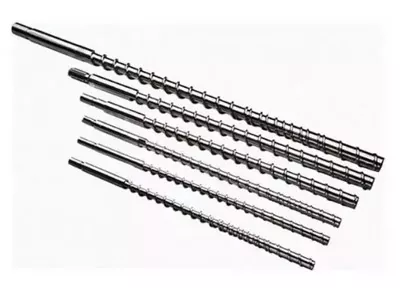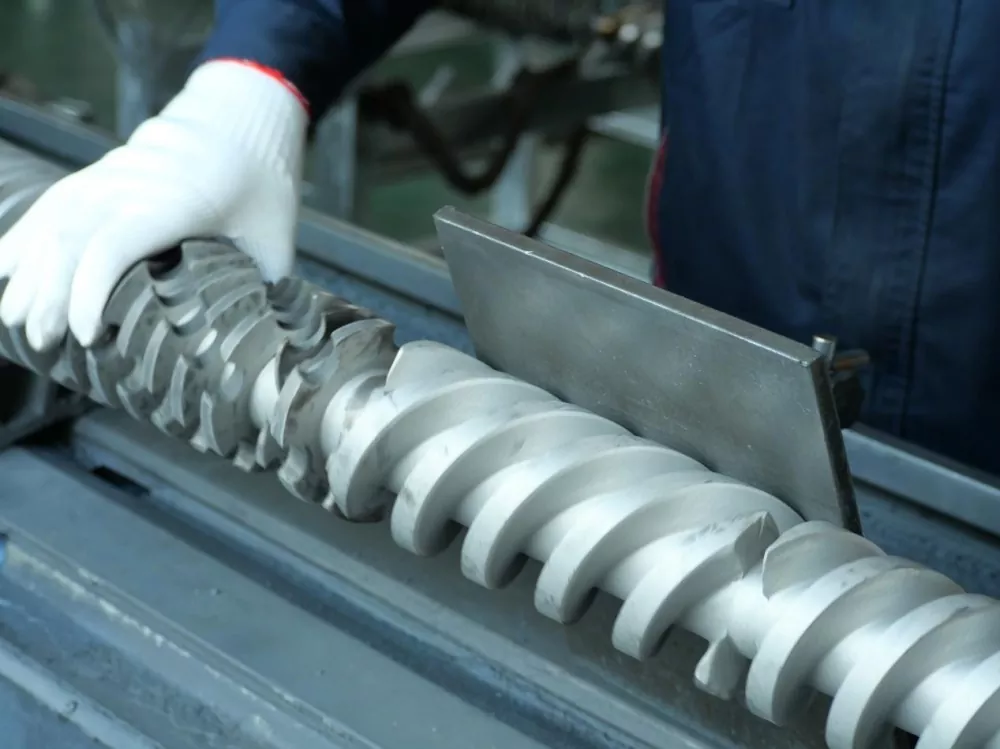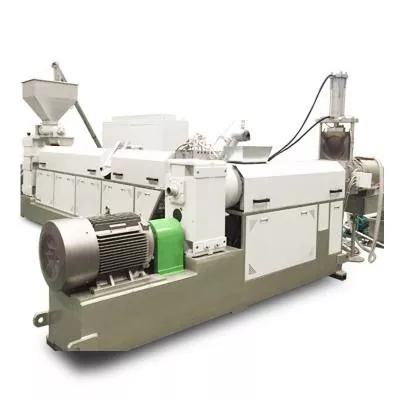

A parallel twin screw barrel holds two screws of constant diameter side by side in a figure-eight bore. The screws turn together and push material forward by trapping it between the flights, rather than dragging it along a wall the way a single screw does. Two design choices decide what the machine can do: the rotation direction (co-rotating or counter-rotating) and how deeply the screws mesh (fully, partly, or not at all). Get those two right and the same hardware compounds, vents, or extrudes rigid PVC.
Ask three suppliers what a parallel twin screw barrel is and you get three vague answers about "two screws instead of one." That undersells it. The twin arrangement changes how material moves through the machine, and that single mechanical difference is why twin screws handle jobs a single screw cannot.
This guide covers the mechanics, the two classification axes that decide performance, the real material specs, and the sizing. For the wider component picture, see our extruder screw barrel guide.
What Is a Parallel Twin Screw Barrel?
A parallel twin screw barrel is the plasticizing unit of a twin screw extruder. It has two parts working as one system: a barrel with two overlapping bores machined into it, forming a figure-eight cross section, and two screws that sit inside those bores.
Parallel means the screws keep the same diameter from feed end to discharge end. The bore stays the same size along its whole length. That is the defining difference from a conical twin, where both screws and bore taper down toward the die.
The parallel form gives the designer a constant cross section to work with along the entire length, which makes it straightforward to build long machines with room for compounding, venting, and mixing sections. The comparison between the two forms is covered in our conical vs parallel guide.
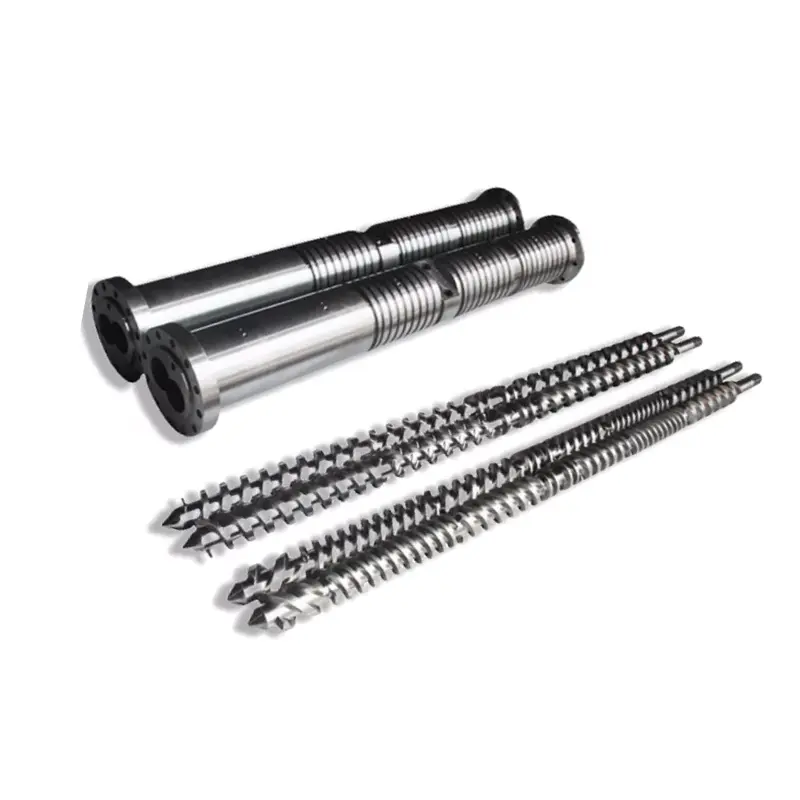
How a Parallel Twin Screw Barrel Works, Step by Step
- Feeding. Material drops into the feed throat and lands on both screws at once. Twin screws take powders, flakes, and irregular feed that a single screw struggles to grip.
- Conveying. The screws turn and the flight of one screw wipes the channel of the other. Material gets trapped in the C-shaped chambers between flights and pushed forward mechanically.
- Melting. Barrel heaters supply part of the heat. The rest comes from shear as the material is worked in the narrow gap where the screws overlap, which is the most intense zone in the machine.
- Mixing. Every rotation splits, folds, and recombines the melt stream. That repeated division is what disperses fillers, pigments, and additives evenly.
- Venting. On a vented barrel, the channel deepens at a vent port so pressure drops to near zero. Moisture and volatiles escape there, often under vacuum.
- Pumping and metering. The final section builds pressure and delivers a steady melt to the die or the pelletizer.
Co-Rotating vs Counter-Rotating: Two Directions, Two Jobs
The screws can turn in the same direction or in opposite directions. That one choice changes the character of the machine completely.
| Co-rotating | Counter-rotating | |
|---|---|---|
| Screw direction | Both screws turn the same way | Screws turn in opposite directions |
| Material path | Follows a figure-eight around both screws | Squeezed through the nip between the screws |
| Shear | High, and adjustable through screw elements | Lower, and gentler on the material |
| Screw speed | High | Lower |
| Pressure building | Moderate | Strong and steady |
| Best at | Compounding, masterbatch, reactive extrusion, filled compounds | Rigid PVC pipe and profile, heat-sensitive material |
Co-rotating screws are the compounding tool. High shear and high speed disperse glass fibre, pigment, and additive thoroughly, which is exactly what a modified compound needs.
Counter-rotating screws act like a positive-displacement pump. The nip between them carries material forward under strong pressure at low shear, and that is what rigid PVC demands, since PVC degrades when you shear it hard. Our counter-rotating parallel twin screw barrels are built for that duty, and the chemistry behind it sits in our PVC screw barrel guide.
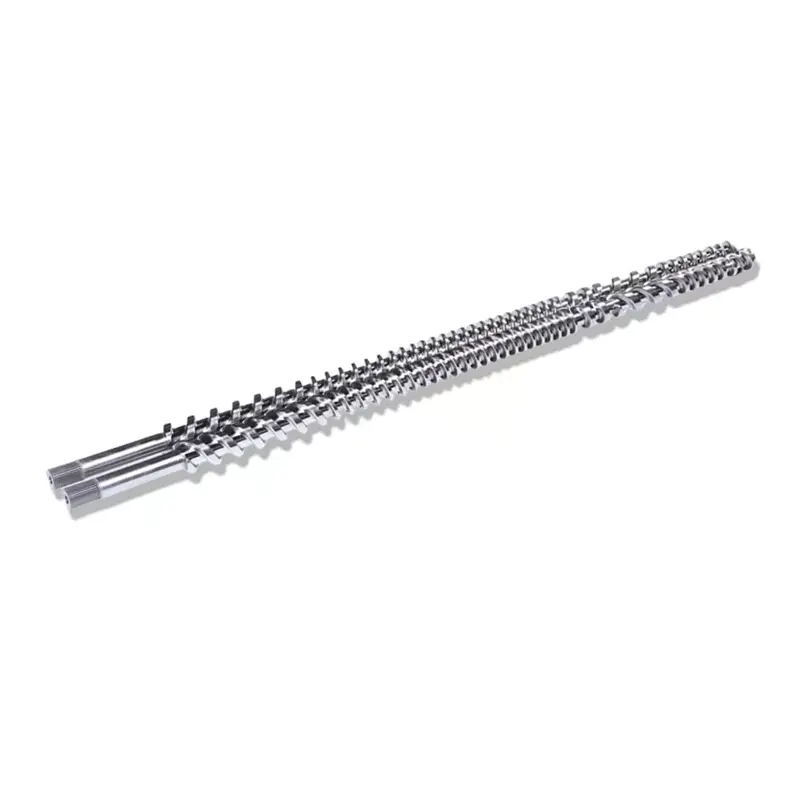
Fully, Partly, or Non-Meshing: The Axis Most Guides Skip
Rotation direction is only half the classification. The second axis is how deeply the two screws engage each other, and most guides never mention it.
Our parallel twin screws come in three meshing types: fully meshing, partially meshing, and non-meshing. The difference is how far the flight of one screw reaches into the channel of the other.
- Fully meshing. The flight of one screw reaches the root of the other, leaving a small gap. This is the most common type in plastics extrusion, because the tight clearance gives excellent shearing and mixing and wipes the channels clean as the screws turn.
- Partially meshing. The screws overlap, but less deeply. Conveying stays positive while shear drops, which suits material that cannot take aggressive working.
- Non-meshing. The screws sit side by side without engaging. The machine behaves closer to two single screws in one barrel, with the gentlest treatment and the least positive conveying.
The practical takeaway is that "twin screw" alone does not describe a machine. Fully meshing and counter-rotating is a different tool from fully meshing and co-rotating, and both differ from a non-meshing arrangement. When you specify a replacement set, the meshing type has to match the machine you own.
Why Twin Screws Convey Differently from Single Screws
A single screw is a drag pump. It relies on friction: material must stick to the barrel wall more than it sticks to the screw, or it simply spins in place instead of moving forward.
That dependency causes real problems. Powders, flakes, and slippery or low-friction feed do not grip well, so the screw surges or starves. Output then varies with how well the material happens to be gripping that day.
Twin screws convey positively. The flight of one screw sweeps the channel of the other, so material is pushed along mechanically whether it grips the wall or not. Output stays steadier, and feed that defeats a single screw goes through without complaint.
That is also why twin screws dominate compounding and PVC powder work. The full comparison is in our single screw vs twin screw guide.
What a Parallel Twin Screw Barrel Is Made Of
The base steel carries the mechanical load. The surface on top of it takes the wear. Here are the specifications we build our parallel twin screw sets to.
| Specification | Value |
|---|---|
| Base material | 38CrMoAlA |
| Heat treatment hardness | HB260–320 |
| Nitriding hardness | HV950–1000 |
| Nitriding depth | 0.50–0.70 mm |
| Nitriding brittleness | Grade 1 or better |
| Surface roughness | Ra0.4 |
| Screw straightness | 0.015 mm |
| Chrome plating hardness | HV950 or higher |
| Chrome thickness | 0.05–0.10 mm |
| Bimetallic hardness | HRC60–65 |
| Bimetallic depth | 2.0–3.0 mm |
Two numbers in that table deserve attention when you compare quotes. Screw straightness at 0.015 mm decides whether the screws run true in a figure-eight bore, and a bent screw wears one side of the bore and destroys its replacement too. Nitriding brittleness is the quality check most suppliers never publish: a hard case that is brittle chips off under load instead of resisting wear.
Beyond the standard build, we customise into hot work steel, cold work steel, high-speed steel, HIP powder steel, and PTA alloys. When the feed is abrasive or corrosive, the bimetallic route replaces nitriding, and our bimetallic vs nitrided guide covers when that pays.
Sizing: Diameter, L/D, and Output
Screw diameter sets throughput. L/D sets how much room the machine has to melt, mix, and vent along the way. Here are our commonly used parallel twin screw models with their published output figures on PVC.
| Model | Screw dia (mm) | L/D | PVC output (kg/h) | Screw speed (rpm) | Motor (kW) |
|---|---|---|---|---|---|
| NHY75 | 75 | 26–36 | 220–350 | 45 | 45 |
| NHY90 | 90 | 26–36 | 280–460 | 45 | 55 |
| NHY110 | 110 | 26–36 | 350–650 | 45 | 75 |
| NHY120 | 120 | 26–36 | 500–800 | 45 | 110 |
| NHY130 | 130 | 26–36 | 680–1000 | 45 | 132 |
Read the pattern rather than just the rows. Output roughly tracks diameter, and motor power climbs with it, because pushing more material through takes more torque. The L/D band stays the same across the range, since the ratio is a design choice rather than a size consequence.
Outside these models we build parallel screws from 45 mm to 150 mm, with L/D from 32:1 to 38:1 on our PVC pipe sets or tailored to your line. What L/D actually buys you is covered in our L/D ratio guide, and the full range sits on our parallel twin screw product page.
What Parallel Twin Screws Actually Produce
Four application families cover most of what these machines do, and they run from raw material through to finished product.
Plastic modification and compounding
The most typical application. Strong shearing and dispersing power lets a base polymer such as PP, PE, or ABS be blended evenly with glass fibre, carbon fibre, flame retardants, and antioxidants. That produces reinforced, flame-retardant, or conductive grades, such as the glass-fibre-reinforced PP used in automotive parts and the flame-retardant ABS used in electronics.
Colour and functional masterbatch
High-concentration pigments, dyes, or functional additives are mixed into a carrier resin, then extruded and pelletized. This produces colour masterbatch for dyeing, or functional masterbatch such as antistatic and antibacterial grades. Twin screws solve the uneven mixing problem that limits single screws on this work.
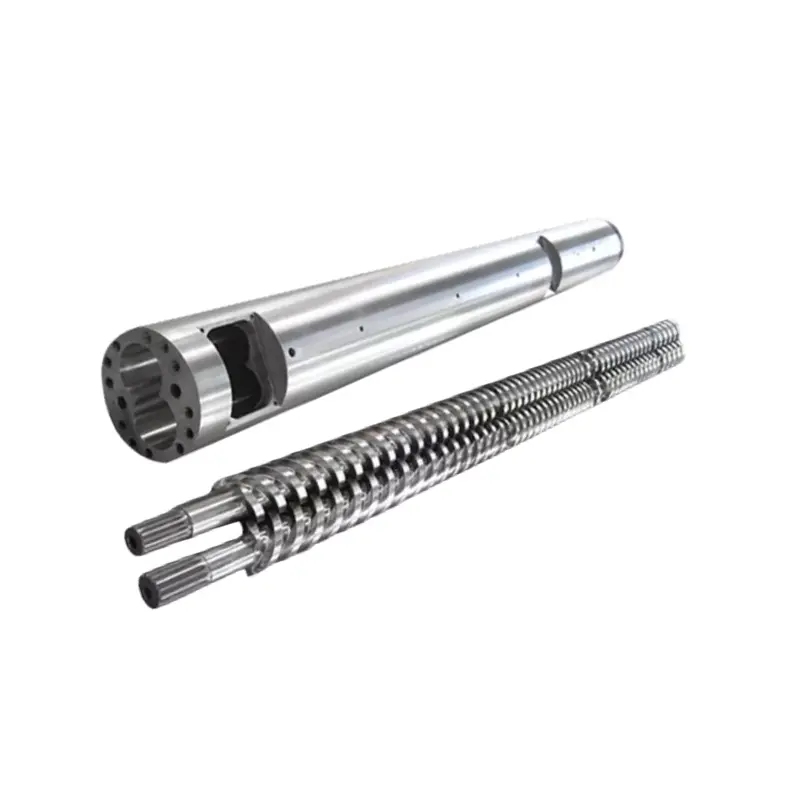
Extrusion moulding
Pipe, profile, sheet, and film. Twin screws suit high-viscosity, hard-to-plasticize polymers such as PVC and PC especially well. PVC drainage pipe, door and window profile, and PC sheet all depend on the uniform plasticization a twin screw delivers, which is what keeps product defects down. Our PVC pipe parallel screw barrels serve water and drainage pipe, electrical conduit, and protective pipe.
Recycled plastic processing
Waste PP and PE go through shearing and heating that removes impurities, relieves stress, and re-plasticizes the material for pelletizing. Recycled feed is inconsistent and often contaminated, which is exactly the kind of material positive conveying handles well.
How to Tell When a Parallel Twin Screw Set Needs Replacing
Twin screw wear shows up in the same places every time, and the machine tells you before the parts look obviously bad.
- Output falls at the same screw speed. Worn clearance lets melt slip backward instead of moving forward.
- Mixing quality drops. Colour streaks or uneven filler distribution mean the screws are no longer wiping each other properly.
- Motor load climbs at constant output, which points at drag, misalignment, or degraded material building resistance.
- Surface quality drifts on the finished product, often the first thing the quality department notices.
Confirm with instruments rather than impressions. Measure flight OD and bore ID against the build drawing, and check the intermesh clearance, which is unique to twin screws and easy to overlook.
Why Work With Nanhaiya
Nanhaiya has built screws and barrels for over twenty years and serves 500+ clients worldwide. Our range of parallel twin screws covers compounding, granulation, PS foaming, aluminium-plastic panel, rubber and plastic, and PVC pipe duty, in co-rotating and counter-rotating configurations.
Every set is machined from 38CrMoAlA and finished to the specifications in the table above, with strict tolerance control and dynamic balance testing before it ships. Our sets are built to suit major extruder brands including KraussMaffei, Cincinnati, and Jwell, and we customise the screw profile, compression ratio, venting design, and heating zones to your line.
Before quoting, our engineers work through the parameters with you: diameter, aspect ratio, screw groove depth, and the material choice. The quote covers product, shipping, and expected maintenance cost, and it reaches you within 12 hours. After delivery, our technicians support installation and commissioning, and after-sales issues get a response within 24 hours.
Need a parallel twin screw set built to your machine? Send your model, drawing, or worn sample, plus the material you run. We quote within 12 hours.
Get a Twin Screw QuoteFrequently Asked Questions
What is a parallel twin screw barrel?
It is the plasticizing unit of a twin screw extruder: a barrel with two overlapping bores forming a figure-eight cross section, holding two screws of constant diameter. The screws convey material forward mechanically by trapping it between their flights, rather than relying on friction against the barrel wall.
How does a parallel twin screw barrel work?
Material drops onto both screws at the feed throat. As the screws turn, the flight of one wipes the channel of the other, trapping material and pushing it forward. Barrel heaters and shear in the overlap zone melt it, every rotation splits and recombines the melt to mix it, and the final section builds pressure to feed the die.
What is the difference between co-rotating and counter-rotating?
Co-rotating screws turn the same way and deliver high shear at high speed, which suits compounding, masterbatch, and filled compounds. Counter-rotating screws turn in opposite directions and act like a positive-displacement pump, building strong pressure at low shear. That gentler action is what rigid PVC pipe and profile need.
What are fully meshing, partially meshing, and non-meshing twin screws?
They describe how deeply the two screws engage. Fully meshing screws reach the root of each other with a small gap, giving the best shearing and mixing, and this is the most common type in plastics extrusion. Partially meshing screws overlap less and reduce shear. Non-meshing screws sit side by side without engaging, giving the gentlest treatment.
What is the difference between parallel and conical twin screws?
A parallel twin screw keeps the same diameter from feed to discharge, and the bore stays a constant size. A conical twin screw tapers, with a larger feed end narrowing toward the die. The parallel form gives a constant cross section along the length, which makes long machines with venting and mixing sections straightforward to build.
Why use a twin screw instead of a single screw?
Positive conveying. A single screw relies on friction, so material must grip the barrel wall to move forward, and powders, flakes, and slippery feed cause surging. Twin screws push material along mechanically regardless of grip, which gives steadier output and lets them handle feed that defeats a single screw.
What are parallel twin screws used for?
Four main families: plastic modification and compounding with glass fibre, carbon fibre, or flame retardants; colour and functional masterbatch production; extrusion of pipe, profile, sheet, and film including PVC and PC; and recycled plastic processing where waste PP and PE are cleaned, re-plasticized, and pelletized.
Do twin screws have to be replaced as a pair?
Yes. The intermesh clearance between the two screws is set during manufacture and cannot be recovered by replacing one screw against a worn partner. Twin screws are produced, supplied, and replaced as a matched pair, and they should be stored and handled that way too.