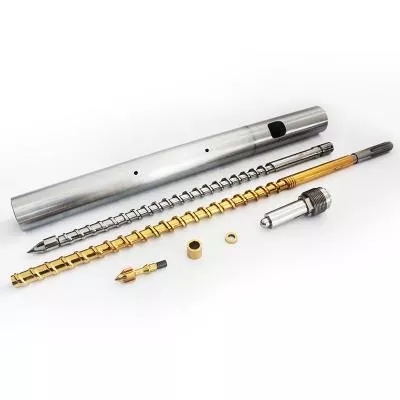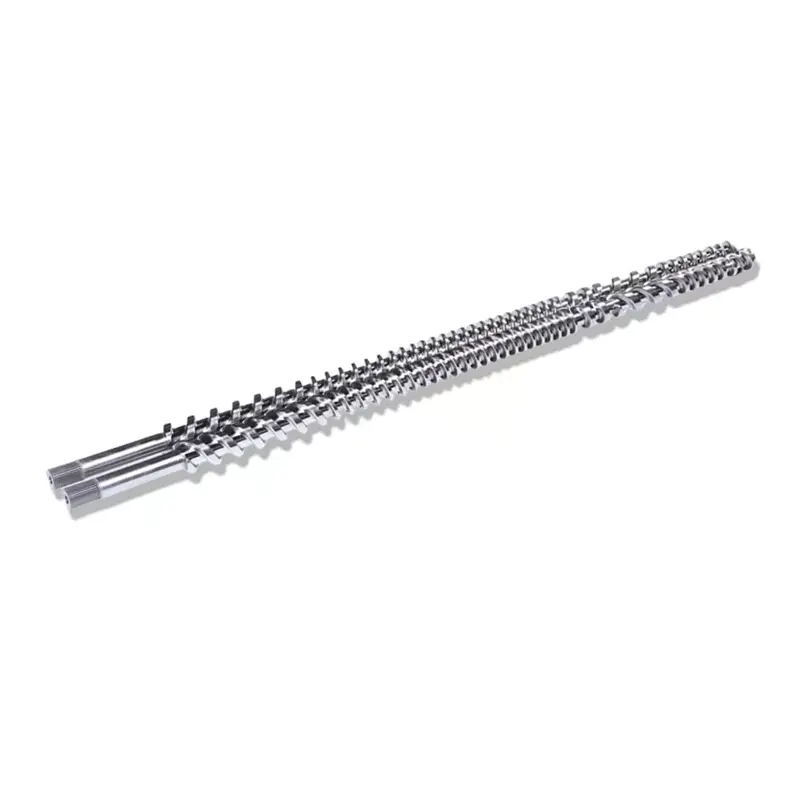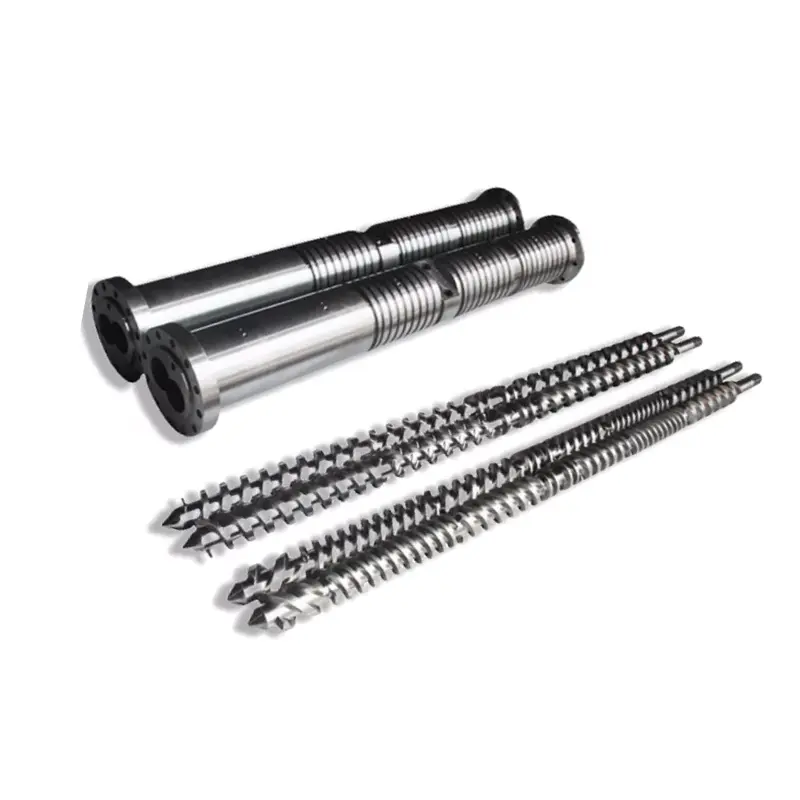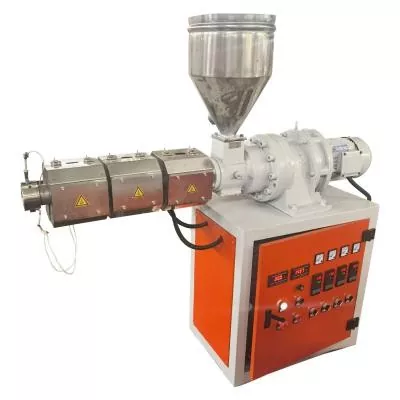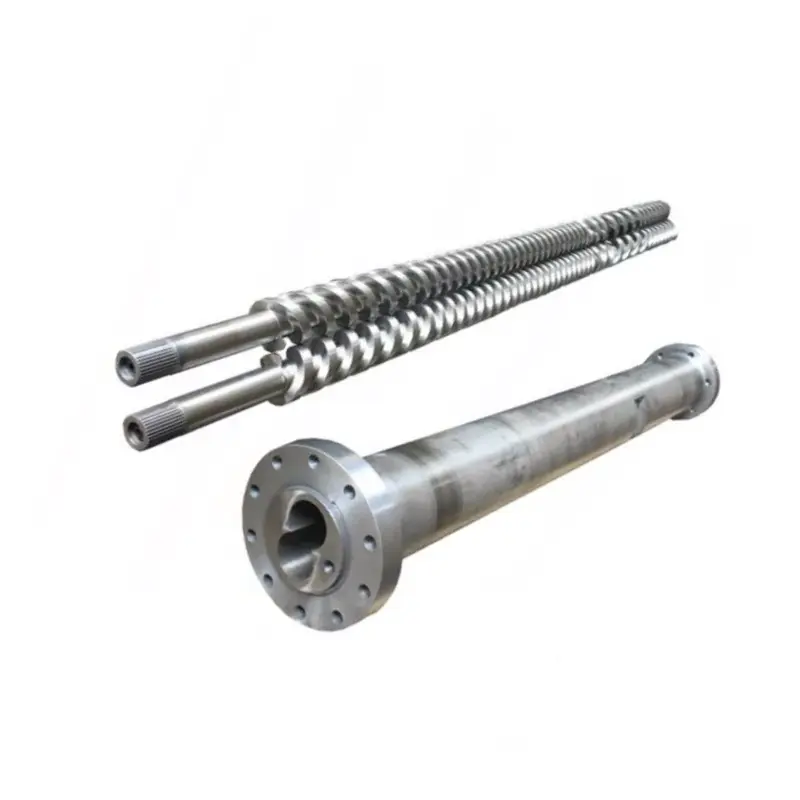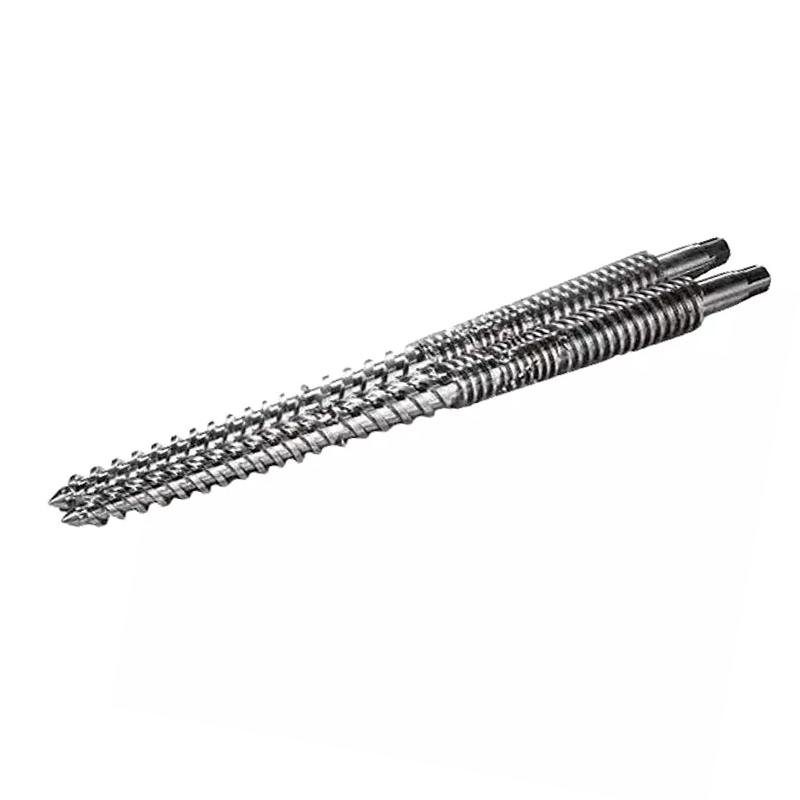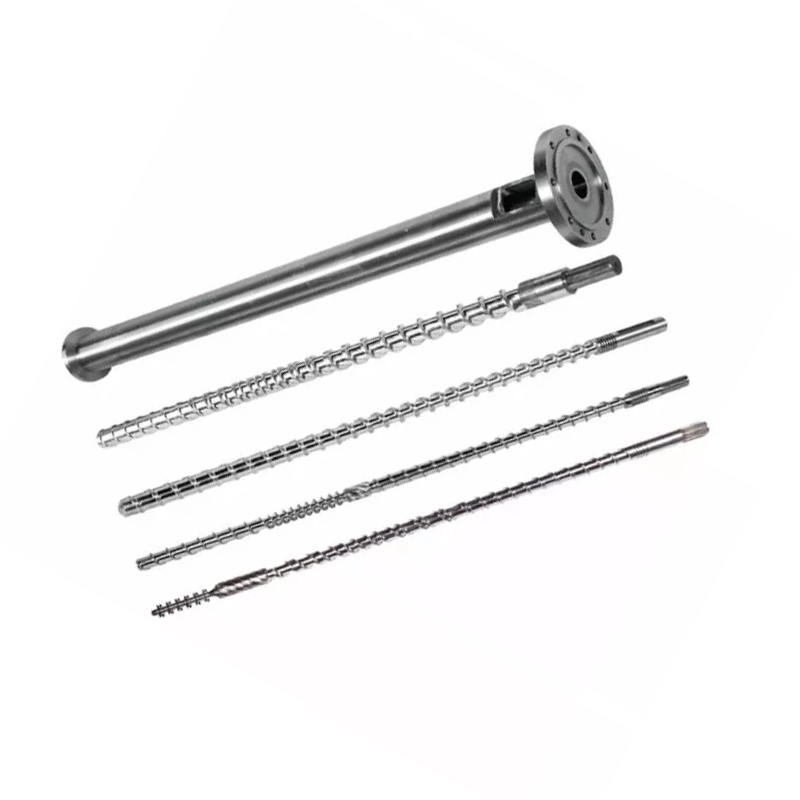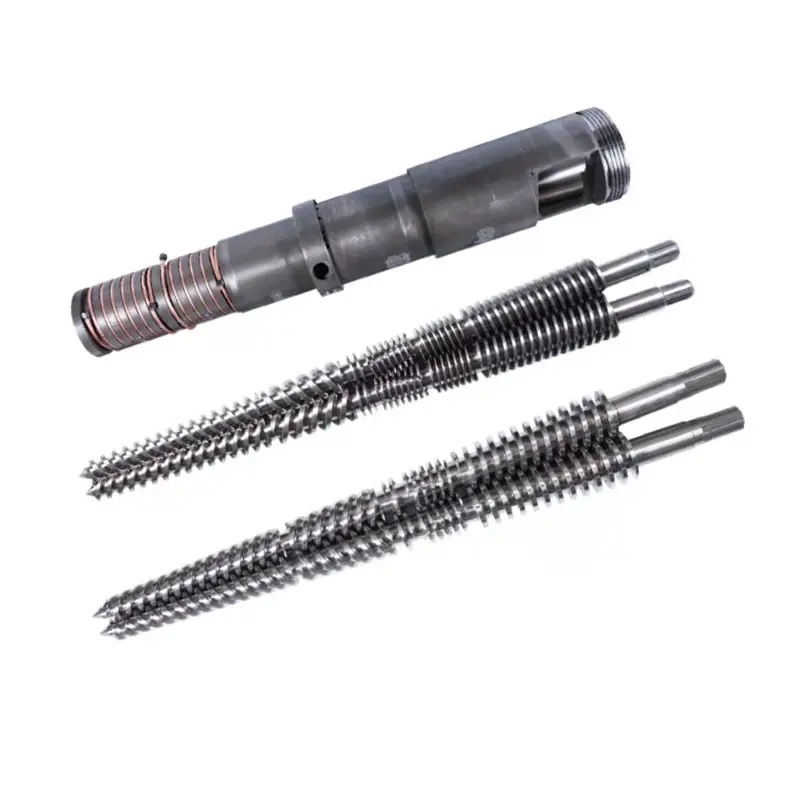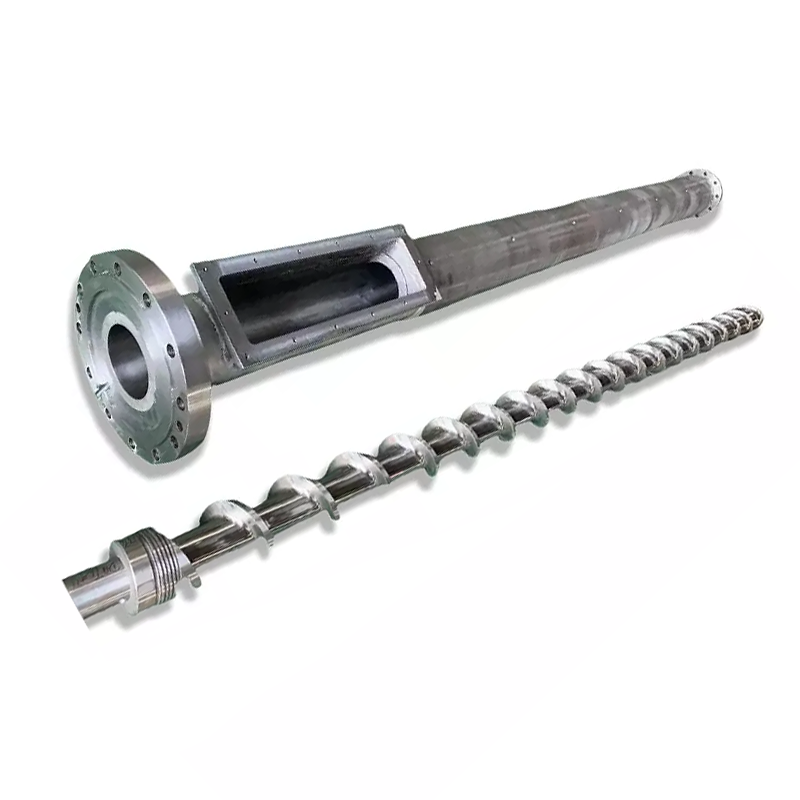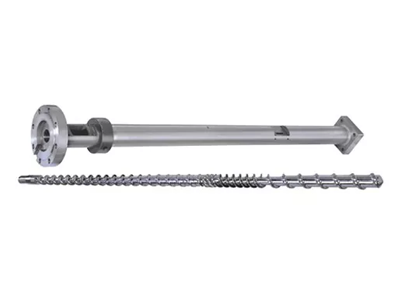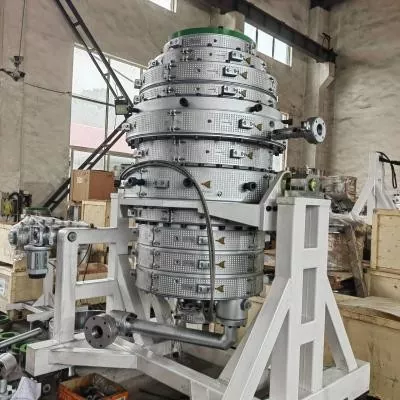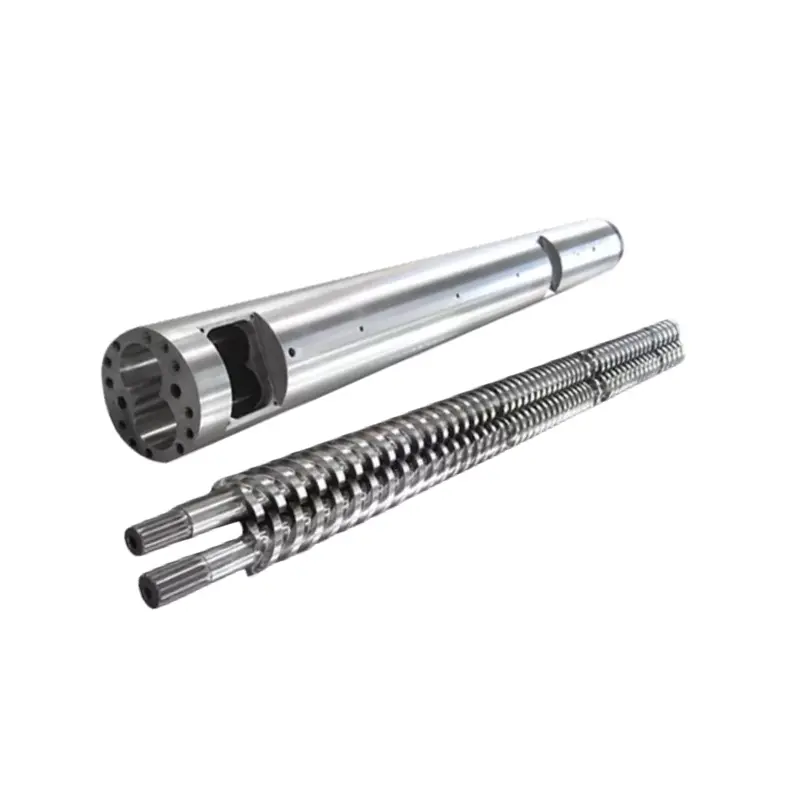

A granulation screw should be specified around what enters the hopper and what the pelletizing line must deliver. Diameter and polymer name alone do not define feeding, devolatilization, mixing or pressure duty.
Quick answer
Specify a granulation single screw in this order: feedstock, required melt preparation, venting load, mixing duty, filtration resistance and pelletizing method. State whether the feed is clean pellet, powder, agglomerate, washed flake or a variable recycled stream. Provide resin grade, MFR test condition, moisture, contamination, filler, target output, motor, rpm, vacuum arrangement and current symptoms. The screw can then be designed around a real material window instead of a nominal diameter.
"65 mm screw for recycled PP granulation" is still a short RFQ
A 65 mm outside diameter tells us what may fit inside the barrel. It says little about how the material reaches the screw or how difficult it is to melt, vent, mix and filter. Recycled PP pellets, washed flakes and low-density agglomerate can behave differently at the same nominal throughput.
The production target also needs a definition. "Good pellets" might mean steady strand formation, low odor, color uniformity, limited black specks, a controlled MFR band or reliable feeding into the next process. These outcomes do not all point to the same screw section.
Our factory view: if an inquiry only says "65 mm recycled PP," we do not approve a flight drawing. We ask what the scrap looked like before granulation, whether it was washed and dried, how the line is vented, which filter is installed, and where instability first appears. A new screw should correct a defined process mismatch. It should not hide an unknown one.

What Nanhaiya publishes for granulation single screws
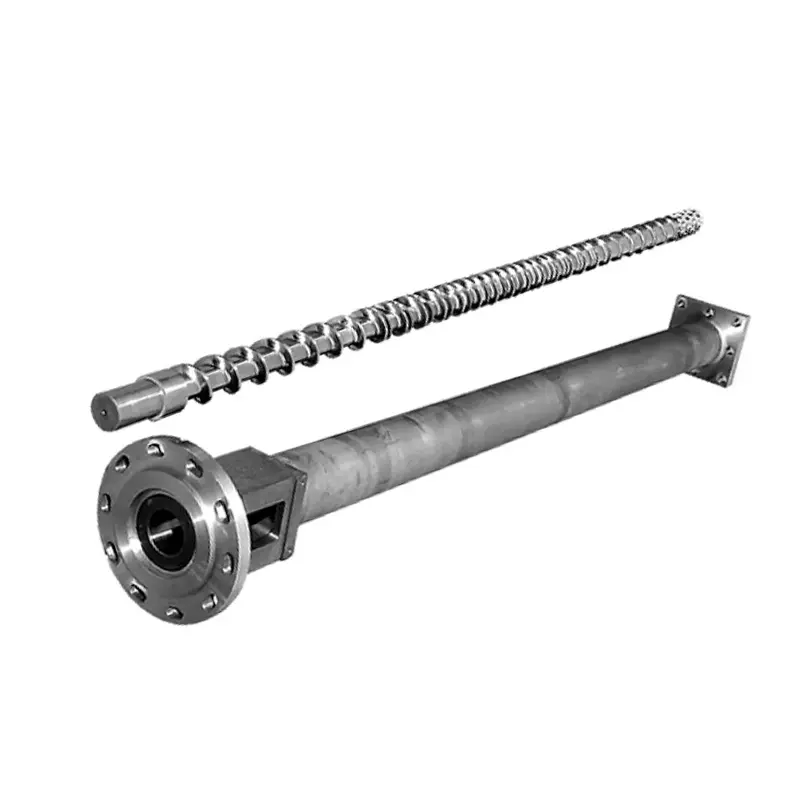
Nanhaiya's granulation single screw barrel page lists PVC pelletizing, plastics modification, color masterbatch granulation, rubber granulation, PVC recycling, compounding and engineering plastics among its application areas. The page says its feed section can use a grooved liner or specially designed threads to improve grip on powdery or viscous materials.
The product page and the broader single screw category publish the same family-level model table:
| Model | L/D | Published capacity | Screw speed | Motor power | Center height |
|---|---|---|---|---|---|
| NHY20 | 20:1 | 3 to 5 kg/h | 10 to 60 rpm | 1.1 / 1.5 / 2.2 kW | 1000 to 1400 mm |
| NHYZS25 | 25:1 | 5 to 8 kg/h | 10 to 60 rpm | 2.2 / 3.0 / 4.0 kW | 1000 to 1400 mm |
| NHY30 | 25:1 | 5 to 10 kg/h | 10 to 60 rpm | 2.2 / 3.0 / 4.0 kW | 1000 to 1400 mm |
| NHY45 | 25:1 to 36:1 | 10 to 120 kg/h | 10 to 150 rpm | 5.5 to 22 kW | 1000 to 1400 mm |
| NHY65 | 25:1 to 36:1 | 60 to 300 kg/h | 20 to 150 rpm | 22 to 75 kW | 1000 mm |
| NHY75 | 25:1 to 36:1 | 200 to 450 kg/h | 20 to 150 rpm | 30 to 132 kW | 1000 mm |
| NHY90 | 25:1 to 36:1 | 180 to 600 kg/h | 20 to 110 rpm | 30 to 185 kW | 1000 to 1100 mm |
| NHY120 | 25:1 to 36:1 | 320 to 1000 kg/h | 20 to 90 rpm | 75 to 280 kW | 1000 to 1250 mm |
| NHY150 | 25:1 to 36:1 | 400 to 1300 kg/h | 20 to 75 rpm | 90 to 400 kW | 1000 to 1300 mm |
Source: Nanhaiya granulation and single screw pages, checked August 24, 2026. Each row covers a broad family. Do not combine the highest published output, speed and motor values into one assumed operating point.
How we treat the 30 percent claims: the granulation page states that its new design can use 30 percent less specific energy and increase output by 30 percent at the same screw diameter. The page does not publish a resin, baseline screw, test method or operating conditions for that comparison. Buyers should treat both figures as Nanhaiya website claims and request a project-specific comparison protocol before putting them into an ROI calculation or acceptance clause.
Define the feedstock before designing the feed section
The first drawing decision starts above the screw. Clean, uniform pellets normally feed more predictably than film flake, irregular regrind, powder or a low-density agglomerate. The hopper, force feeder, feed throat, cooling and first flights must be considered together.
Recycled material needs a wider description. A 2024 Nature Communications study on mechanically recycled polyethylene notes that variability in recycled feedstocks makes manufacturing suitability difficult to assure. The study used rheology and extrusion experiments to investigate degradation pathways. For an RFQ, this supports a practical rule: provide a range and sampling method for the material, not one ideal laboratory value.
Record these feed variables
- Polymer family, supplier, grade and known blend ratios
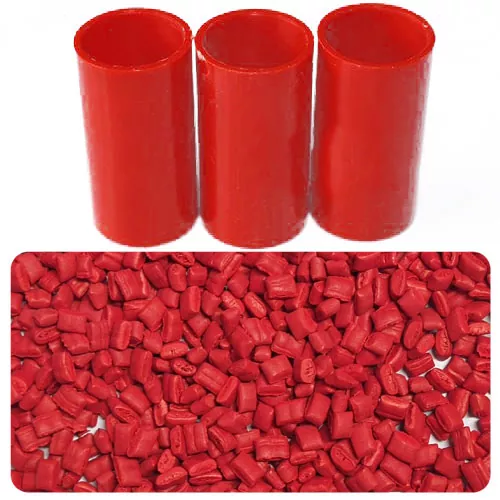
- Pellet, powder, regrind, flake or agglomerated feed form
- Particle-size distribution and bulk density range
- Moisture, washing method, drying method and storage condition
- Paper, metal, wood, labels, sand or incompatible-polymer contamination
- Masterbatch, pigment, mineral filler, fiber and process-aid levels
- Normal recipe, worst recipe and frequency of recipe changes
Include MFR or MVR with the test temperature and load. ASTM D1238-26 states that melt-flow data can indicate flow-rate uniformity for quality control, but it is not proof that other properties are uniform without a valid correlation. Include MFR in the data pack, but do not use it as a substitute for material and process details.
A vent is a process section, not a hole in the barrel
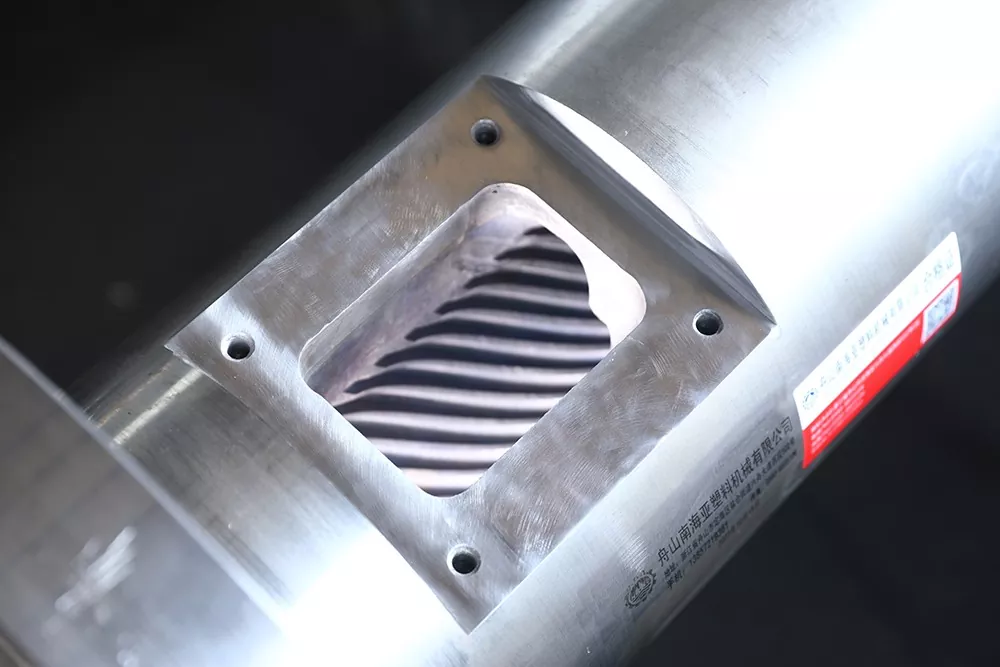
Venting removes unwanted volatile components from a polymer melt. The screw must first create melt, then expose it in a partially filled extraction section while maintaining stable transport toward the downstream metering and pressure-building section. If the channel is too full at the opening, polymer can flood the vent. If melt preparation is poor, the vacuum system cannot correct the upstream problem by itself.
A 2017 paper titled "Modeling devolatilization in single- and multi-screw extruders" describes vacuum-vented extruders and explains that extraction sections operate partially filled. Volatiles leave the rotating melt pool and wiped melt film, while surface renewal supports mass transfer. This is why vent location, channel fill, surface renewal and vacuum capacity belong in the same engineering discussion.
Our factory view: we will not add a vent merely because the material is recycled. First we ask what must be removed and whether washing and drying already control it. A vented design needs room for melting before extraction and enough downstream screw length to rebuild pressure. On a short existing barrel, those zones compete for the same length.
Choose distributive or dispersive mixing for a named problem
Distributive mixing rearranges and spreads components through the melt. It is useful when the problem is color or temperature uniformity without a hard agglomerate that must be broken down. Dispersive mixing applies higher stress to reduce agglomerates or disperse pigments and fillers. The two duties are related, but they are not interchangeable.
A 1996 flow-modeling study of Maddock, Dulmage and blister-ring elements found different pressure behavior. In that study, the Maddock and blister-ring elements were dispersive and generated high pressure drop, while the Dulmage element was distributive and produced a lower pressure drop. The practical lesson is simple: a mixer changes pumping and energy demand as well as mixing.
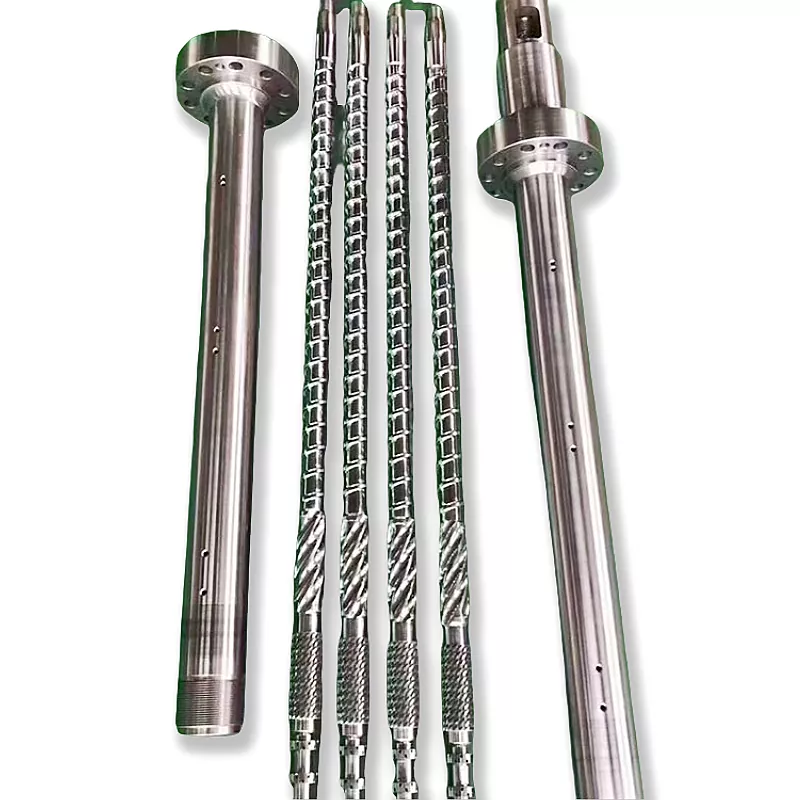

Nanhaiya's transparent granulation page states that its screw uses smooth transitions without dead corners to reduce cross-contamination during material and color changes. It also lists 38CrMoAlA, ion nitriding and hard-chrome electroplating among its material and surface references. These describe website options. The approved drawing and quotation must identify which base material and surface system apply to the actual order.
The current transparent granulation page contains conflicting compression-ratio data. Its parameter table gives 3.5:1 to 4.5:1, while its production-details section gives 2.0:1 to 2.5:1. The page also publishes common diameters of 35, 45, 65, 75, 85 and 90 mm; a general L/D range of 20:1 to 30:1; and 20:1 to 25:1 for heat-sensitive PVC. We preserve those site values here, but neither compression-ratio range should enter a purchase order without material-specific review.
The screw cannot be specified separately from the filter and pelletizer
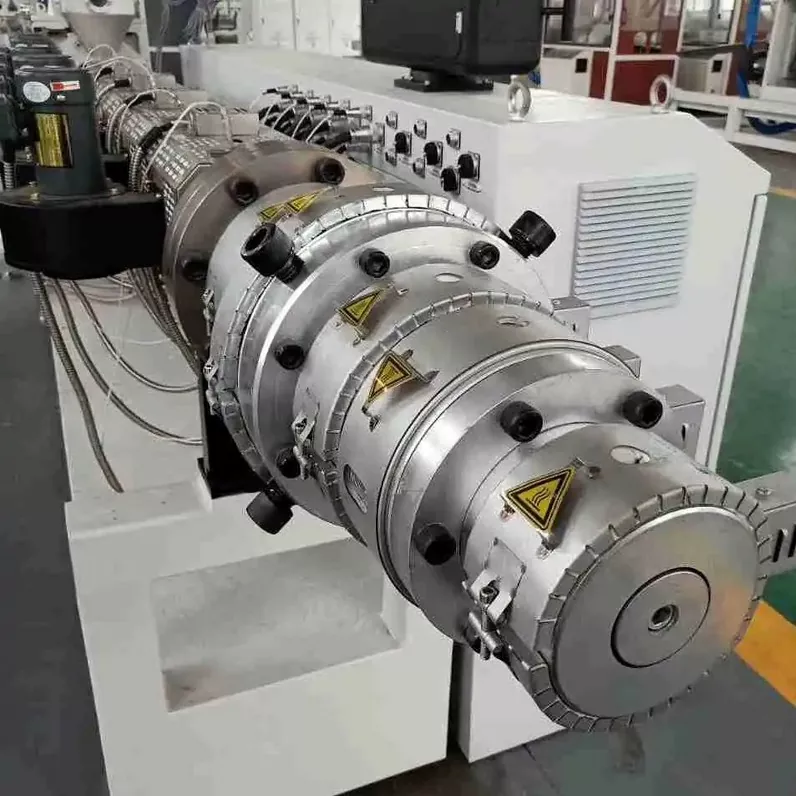
A contaminated recycled stream may require frequent screen changes or a more restrictive filtration system. That resistance changes the pressure the screw must generate. If the filter blocks quickly, the line may show pressure rise, output loss or vent instability even when the screw itself is undamaged.
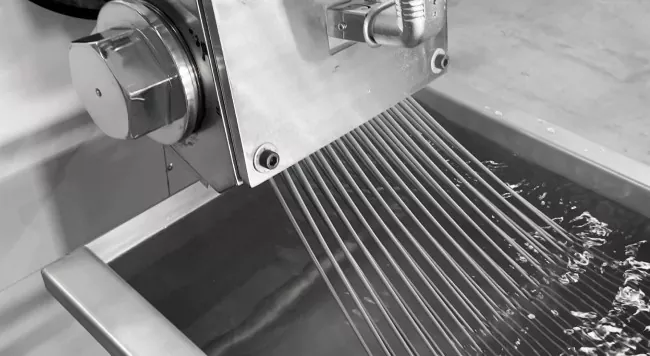
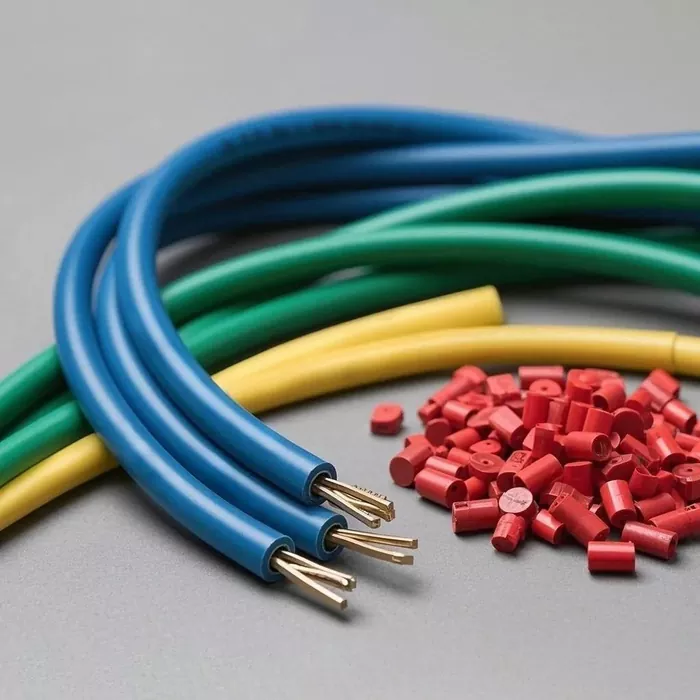
The pelletizing method also matters. Strand lines need steady flow through the die so strands enter the water bath consistently. Other cutting arrangements impose their own die and pressure conditions. Send the die-hole count and dimensions, screen changer or filter type, breaker plate, expected clean and dirty pressure, and pelletizing method with the RFQ.
Match the screw review to the granulation job
| Granulation job | First information to verify | Screw or line decision to review | Common wrong assumption |
|---|---|---|---|
| Clean regrind or known virgin resin | Grade, regrind size, MFR condition, output and present screw performance | Preserve a simple proven geometry if the process window is stable | More mixing must improve the pellets |
| Washed film flake or agglomerate | Bulk density, residual moisture, feeding consistency and contamination | Feed-section grip, drying, venting and filtration | Nominal polymer type predicts feed rate |
| Powdery or viscous PVC formulation | Full recipe, thermal sensitivity, feed method and permitted residence time | Grooved liner or thread concept, cooling and controlled melting | A published temperature profile applies to every PVC recipe |
| Color masterbatch | Pigment type and loading, carrier resin, dilution target and agglomerate evidence | Decide whether distributive or dispersive work is needed | One "mixing screw" solves every pigment problem |
| Transparent granulation | Resin, contamination limit, color-change routine and optical defect description | Surface finish, stagnant-zone control, mixing and thermal history | High average plasticization guarantees clean pellets |
| Filled or fiber-containing compound | Filler type, loading, particle size, abrasion, required dispersion and property target | Mixing stress, wear protection, motor margin and process choice | A harder surface compensates for the wrong mixer |
When a single screw may be the wrong purchase
A single screw is a sensible choice when the material range and required mixing duty fit a stable design. We would review another process architecture when a project requires strong dispersive compounding, handles several incompatible or heavily filled ingredients, needs high devolatilization duty, or receives feedstock whose composition changes too widely for one screw window.
That does not mean every recycled product needs a twin screw. It means the buyer should compare process requirements before ordering hardware. If the project is primarily compounding rather than remelting and pelletizing, review Nanhaiya's parallel twin screw range as a separate option.
Our factory view: we would rather tell a buyer that the proposed single screw is too narrow for the job than sell a complex screw and argue about pellets later. A low purchase price loses its advantage if the line cannot stay within a stable operating window.
Factory and replacement checks before the drawing is released
For a replacement order, measure the barrel bore and screw flights by zone. Do not treat a worn sample as the original diameter. A new screw installed in a worn barrel can retain excessive clearance and leakage. The wear-measurement guide explains the mapping logic, while the replacement specification guide lists the drawing and connection fields.
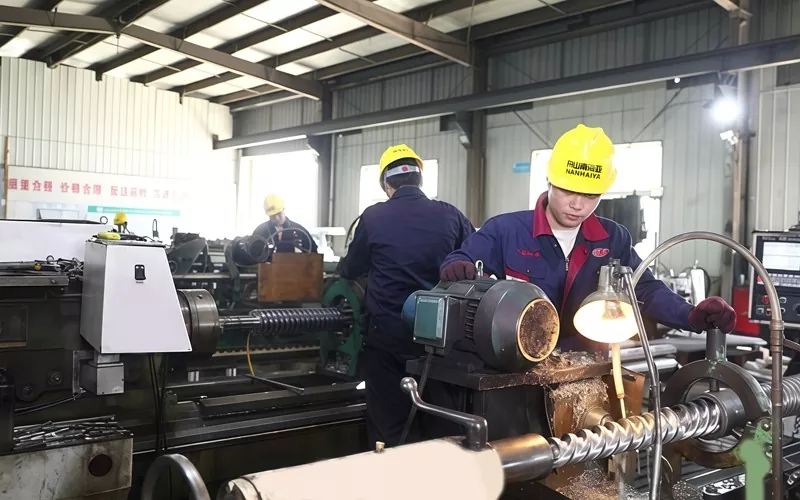
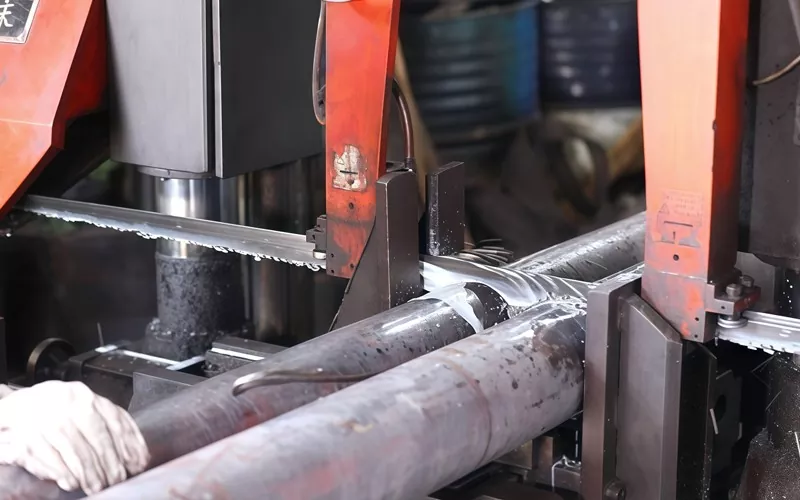
Nanhaiya's equipment page publishes a CNC saw feed error of no more than 0.1 mm, CNC lathe capability for workpieces up to 6 m, and 0.02 mm positioning accuracy for drilling and milling. It also describes five-axis machining for irregular flights and special flanges. These are company-published factory references. Order-specific inspection points still belong on the approved drawing.
If unstable output is the reason for replacement, first follow the checks in the single screw surging diagnostic guide. If the question is whether a conventional or mixing geometry should be used, see the screw geometry comparison. This granulation page owns the application decision. Those pages own diagnosis and geometry comparison.
Granulation single screw RFQ checklist
- Resin supplier, grade and blend ratio
- Virgin and recycled percentages
- Pellet, powder, flake, regrind or agglomerate
- Bulk density and particle-size range
- Moisture, washing and drying process
- Contaminants and incompatible polymers
- MFR or MVR with test temperature and load
- Pigment, filler, fiber and additive levels
- Normal and maximum output targets
- Screw diameter, L/D and overall length
- Motor power, gearbox ratio and rpm range
- Feed throat, force feeder and hopper details
- Vent position and vacuum-system data
- Screen changer, filter and breaker plate
- Die-hole data and pelletizing method
- Operating pressure, melt temperature and load
- Barrel-bore and screw-wear measurements
- Current defect, symptom and operating history
Mark unknown fields as unknown. Do not estimate a drive connection, barrel bore, vent position or process value merely to complete the form.
Frequently asked questions
What information should I send for a granulation screw quotation?
Send the resin and feed form, virgin or recycled percentage, contamination and moisture information, additives and fillers, MFR with its test condition, target output, motor and screw speed, vent and vacuum arrangement, filter type, pelletizing method, drawings and the current production problem.
Does a vented barrel automatically solve moisture and volatile problems?
No. The material must be prepared correctly, and the screw must create a suitably filled extraction section without flooding the vent. Vent location, vacuum capacity, melt temperature, throughput and downstream pressure all affect the result.
Is a stronger mixing section always better for granulation?
No. Distributive mixing and dispersive mixing solve different problems. A more restrictive element can consume pressure and add shear heat. The factory should choose the mixing section around the color, filler, agglomerate and temperature-uniformity requirement.
Can the same granulation screw process clean pellets and recycled flakes?
It may process both within a defined window, but flakes and pellets can feed differently. Bulk density, particle size, moisture, contamination and formulation variability must be disclosed before the feed section and operating range are approved.
Are Nanhaiya's published output capacities guaranteed for recycled material?
No. The published table is a family-level reference. Actual capacity depends on material, feed consistency, moisture, filtration resistance, venting load, motor, screw speed, die or pelletizer and the accepted melt quality.
Which compression ratio should a transparent granulation screw use?
Nanhaiya's current transparent granulation page contains two different references: 3.5:1 to 4.5:1 in its parameter table and 2.0:1 to 2.5:1 in its production details. Neither should be copied into an order without material-specific engineering review and an approved drawing.
Ask Nanhaiya to review your granulation line
Zhoushan Nanhaiya Plastic Machinery Co., Ltd. was established in 2014. Its website lists custom screw design, alloy spray welding and full product manufacturing among its capabilities.
Email: info@nhyscrew.com
Phone: +86-13505809643
Mobile / WhatsApp: +86-13587082002
Address: Block C, No. 2 West Section, Xingzhou Avenue, Dinghai District, Zhoushan City, Zhejiang Province, China
Sources checked
- Nanhaiya, Granulation Single Screw Barrel. Applications, feed-section statement, model table, company claims and hosted media.
- Nanhaiya, Transparent Granulation Single Screw. Published geometry, material, surface and application references, including the disclosed compression-ratio conflict.
- Nanhaiya, Single Screw. Family-level model table, material references and granulation applications.
- Nanhaiya, Production Equipment. Published machining capability and factory photographs.
- ASTM D1238-26. Melt-flow-rate test method, stated use and limitations.
- "Defining quality by quantifying degradation in the mechanical recycling of polyethylene", Nature Communications, 2024.
- "Modeling devolatilization in single- and multi-screw extruders", 2017.
- "Non-newtonian flow modeling in the mixing section of a single-screw extruder with flow analysis network method", Polymer Engineering & Science, 1996.
Technical note: Nanhaiya website values are reproduced as first-party references, not universal operating recommendations. Final geometry, material, treatment, tolerances, inspection, output acceptance and commercial terms are controlled by the approved drawing, quotation and purchase contract.